“For I decided to know nothing among you except Jesus Christ and him crucified.” (1 Corinthians 2:2)
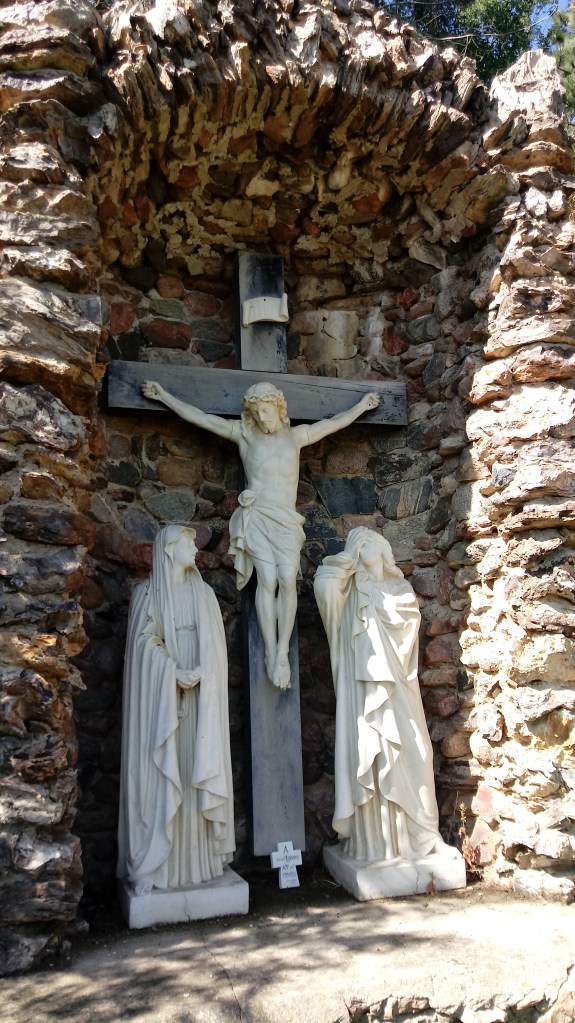
One way to confirm that you have entered a Catholic church is to look for 4 things: a tabernacle that houses the Eucharist, a font for holy water, statues of saints, and a crucifix in the sanctuary. Why a crucifix?
I vividly recall a conversation I had with a couple many years ago. The husband was having serious reservations about his wife learning more about and potentially joining the Catholic Church. One of his objections was the crucifix prominently displayed in our parish’s church.
“Why do you Catholics keep Jesus on the cross in your worship space? I worship Jesus risen from the dead! He did not stay on the cross, and Jesus on the cross should not be our primary focus when we gather for worship. How can I possibly explain to my little boy about the crucifixion—it’s such a horrible, bloody and violent act! I don’t want him to be thinking about Jesus’ suffering and tortured death, but about his glorious resurrection. This whole focus on the crucifixion in your church’s art and architecture just seems to forget the end of the story!”
Addressing his concerns really made me think hard about the crucifix. Why, in heaven’s name, do we Catholics keep “putting Jesus back on the cross”? Why can Catholics talk with each other about how beautiful a particular crucifix is when in reality it depicts the bloodiest, most painful and most humiliating way to kill a person even invented? Why do we see the crucifixion as a source of inspiration and comfort when none of us would ever wear little hangman’s nooses or firing squads or an electric chair around our necks or display them in our home?
I think this man was identifying something unique and critical to our Catholic culture, and it is worth exploring. Displaying a crucifix teaches the truths of our faith visually rather than verbally. But now, with elements of our Catholic culture so often hidden or dismissed even by those who practice it, it makes sense to verbally explain the “sign” of the cross.
When a Catholic gazes upon a crucifix, what do we see? Do we see an innocent man who is dying an agonizing death at the hands of a repressive regime? Do we see a commentary on the failure of good (and weak) individuals to overcome the enormity (and power) of evil? Do we see an indictment on humanity as we gaze upon the way we deal with those who are truly good, truly innocent, and truly pure?
No, those insights or lessons are not what the Church proposes when a crucifix is displayed. To unpack the real message, let’s begin with St. Paul. In his first letter to the Corinthians (1:17-25, 2:1-2), he spoke of the foolishness and weakness of God on display in the Gospel of Jesus Christ crucified. He referred to the “word of the cross.” The cross was meant by the Romans to speak words of warning and terror: don’t “cross” us who are your captors and rulers, or we will “cross” you in this terrible way. But God took those words of terror, of humiliation and suffering, and He spoke a new word with them.
[The cross is] “the living book in which we learn definitively who we are and how we ought to behave. This book is always open before us.”
Pope Saint John Paul II, Address, April 1, 1980
The wounds of Christ crucified do not speak words of failure or condemnation or recrimination. The wounds of Christ do not shout out about how undeserving, thankless and horrible we are. The wounds of Christ do not warn us of impending doom, of God’s uncontrollable wrath, or of His final rejection of all those who sin. The wounds of Christ speak, wordlessly, of unspeakable mercy, of unfathomable compassion, of undying love. Let’s explore four “words” spoken by the crucifix: the word of love, of clarity about sin, about the nature of redemption and sacrifice, and of the expected response of the disciple
What principal word does the crucifixion speak to us? Love. A certain kind of love—sacrificial, redemptive love that seeks good for the other without regard to cost to self. Rescuing love. Redeeming love. Undeserved love. Courageous love. Transformative love. The crucifix is a sign of the mystery of God’s extravagant love for each and every human person. As our Catechism tells us: “There is not, never has been, and never will be a single human being for whom Christ did not suffer” (paragraph #605).
We gaze upon the crucifix and hear the testimony of God whispered in our hearts: “I love you. See how much you’re worth! You are worth saving—you are worth dying for. See how precious you are to me! See what true love is capable of offering for you, my beloved. See how I can take all things—ALL THINGS—and work them for good.” The crucifix speaks, by words of the Spirit, of “Christ the power of God and the wisdom of God” (1 Cor 1:24).
“For every soul is a wonderful treasure … Every single person is worth all the blood of Christ”
St. Josemaria Escriva, Christ is Passing By, 80
In addition to the word of love, the crucifix speaks a word of clarity. Viewing a crucifix, the veil is torn from our eyes, the cloudiness of our judgment is cleared away. We see that all sin is death. All sin is ugly. All sin is used by the devil to lead us away from God. When we gaze upon the crucifix, we see the hard and horrible reality of sin. Our efforts to deceive ourselves about sin being just a minor aberration or a “mistake” are revealed. We can no longer justify or rationalize our sinfulness as being anything other than tinged with death and decay. Sin is revealed as an idolatrous trust in the “un-god” that eventually leads to ultimate, eternal separation from God.Is this good for us to consider? It’s uncomfortable and painful, but yes, yes it is!
In addition to clarity about sin, the crucifix also speaks a word of redemption. As we recognize the hideous truth of sin, we also see revealed the glorious truth of our God. Rather than allow us to receive the full effects of sin that we unleash into our lives, He steps into the breach, He crosses the barrier and places Himself in between us and our sins. He takes the consequences on Himself and, being Love incarnate, He takes it out.
The redemptive death of Jesus on the cross could only happen if He is truly “God in the flesh.” The incarnation, the miracle of the Son of God taking on our humanity without losing His divinity, occurred because God sought to pay the debt of our sin—a debt we could not pay by ourselves. From the moment our sins were revealed and we remained unrepentant in the Garden of Eden, God’s plan of salvation began to unfold—and all those plans depended upon a perfect, pure sacrifice to undo death’s grip on our souls. Why? Because of what sin is. Sin is a negation of truth, a rejection of love and an exaltation of the created over Creator.
The only way to undo these real failures is through a real sacrifice—to offer the best and the purest to God as an act of trusting love. Sacrifice requires action. We can’t think our way out of this dilemma. We can’t feel our way out of this dilemma. We need to act with all the capacities of our humanity—uniting our will with our thoughts, emotions and bodies in a human act of perfect love. But only God can love with enough purity and power to be effective. And only a human can offer the sacrifice to God in reparation for humanity’s sin. This is the point of the incarnation. We need God to act in and through our humanity so that humanity can once again find our way back to God’s heart. Jesus, fully human, can act as the new Adam—the representative of all humanity before the God we have rejected by our sinfulness. Jesus, fully divine, can win the effects of this sacrifice for all humanity by the perfection of His love.
“A God who makes himself flesh and sacrifices himself for the life of the world throws human wisdom into crisis.”
Pope Emeritus Benedict XVI, Corpus Christi 2007
When we gaze upon the crucifix, we are not simply gazing upon a terrible instance of man’s inhumanity to man. That would be devastating, disempowering, discouraging. No one could be saved or healed by that—although we might be inspired to fight to change things if we can avoid being traumatized by it. We don’t keep a crucifix around because of what it is, but because of Who is stuck on it and why—the God-man who came to save, not to condemn.
Jesus’ death on the cross is the perfect sacrifice of the perfect Lamb for our redemption, but how do we receive the effect of this sacrifice? Through the Eucharist. A crucifix is prominently displayed in the sanctuary of a Catholic Church so that at every Mass we can literally see the connection between Christ’s redemptive sacrifice won on the Cross and the Sacrifice of Holy Mass, at which we receive the fruit of that sacrifice.
Jesus taught us this fact at His Last Supper—the meal at which He anticipated and explained the meaning of His great sacrifice. He blessed and broke the bread of the Passover meal and told us that it was now His body, given for us. He told us the cup of wine He held was now His blood-the blood of the covenant sacrifice made between God and each human person. We eat the Body and Blood of Jesus so that the reality and the effects of His sacrificial death are incorporated into our very bodies. The tree upon which Christ was nailed becomes the Tree of Life and we are invited to take the fruit and consume—giving the gift of eternal life to all who partake.
We Catholics embrace the reality, the sensibility, of God’s grace—God continually offers us signs so that we can begin to understand what is truly unfathomable. So that we can receive a gift that is too huge to be comprehended. So that we can become what God designed us to be—and what we cannot become on our own: His beloved children, heirs to the Kingdom and temples of the Holy Spirit.
After reflecting on the words spoken about redemption and sacrifice, we also should consider that the crucifix speaks a cautionary word about the demands of discipleship. It’s easy in our fallen world to seek comfort above all else—to desire the soft, the undefined, the “squishy”—rather than the hard, uncompromising, unsettling real truth. God’s redemptive plan is good, but not comfortable. God’s redemptive plan is life-giving, but not pleasant. God’s sacrifice is effective, but not enjoyable. The crucifix reminds us of these hard truths—and reminds us that God works in the same way in those who become “little Christs” through His Son, Jesus Christ.
Why depict our Savior, Jesus Christ, who now reigns forever in the glory of heaven, at that point in time when He was at His weakest, most vulnerable, and most forsaken state? Why look at a crucifix? Because we, who do not belong to this world, are still in the world—and, wow, are we in deep! We see around us numerous instantiations of the crucifixion, of fallen man’s desire to destroy and demean pure love. But, as Christians, we can look at all these examples and not despair—if we see them through the lens of Jesus’ crucifixion and unite our sacrifices to His.
Those wounds of Christ keep whispering to us: “I have told you that to be my disciple you must die to all that doesn’t lead to me. True love costs something in this fallen world, but don’t give up, don’t despair! This is not the end of the story, death and suffering are the means to a greater end! Unite your sufferings to mine on the cross. Don’t strive to escape or deny or belittle your sufferings—they are, in the hands of Almighty God, the very instruments of your victory. United to my cross, all will prove victorious!” Without these words, the suffering of the innocents among us would be too much to bear.
The final word of the crucifix is one spoken not by Jesus, but by each of Jesus’ followers—it is a word, or more precisely a battle cry, of defiant courage and militant joy. As we display the image of Our Savior’s hideous death, we taunt the powers that seek to freeze us in fear and make us abandon hope. We take up the sign of Jesus’ apparent defeat and raise it up, proudly, as the sign of His true and glorious victory. While we cling, clearheaded and confident, to Christ crucified on the cross, we are under no delusions about the price of discipleship. We are immoveable, unshakeable in the conviction that nothing, nothing, can take us away from the love of God made visible in Jesus Christ. If we can turn the sign of the worst sin ever committed by humans against God into a sign of reverent thanksgiving and devotion, what weapon could possibly defeat us? If we cling to the cross, who can possibly keep us out of heaven?
“He will provide the way and the means, such as you could never have imagined. Leave it all to Him, let go of yourself, lose yourself on the cross, and you will find yourself entirely.”
St. Catherine of Siena
That’s why we prominently display crucifixes in our churches, in our homes, on our bodies and elsewhere. The intent is never to deny the Resurrection, but to remember the miracle before the Resurrection—the miracle of the Father loving us enough to offer the Son for our sake. God’s glorious victory came about precisely through His apparent, utter defeat. Good Friday necessarily comes before Easter Sunday. The crucifixion comes before the empty grave. This side of heaven, we exist in a broken and sinful world. We exist within the realm of the crucifix—living in joyful hope for the empty tomb that awaits us all.
Our Blessed Mother’s example can inspire us. She remained with her Son throughout His Passion and witnessed His death. Her love was strong enough to keep her near her beloved Son—even when she could do nothing to take away His suffering. She was crucified, for her part, with grief: nailed to a cross of compassion and pouring out her life for her Son as He poured out His life for each one of us.
Mary, as the perfect disciple, demonstrates where we need to be when the people around us suffer. Even when we can do nothing to ease their suffering—we stay near the cross. We remain in silent witness to the power of Love: a power revealed through presence. We will not back down, turn away or hide our faces—we will confront evil, death, suffering with the power of love. That power appears weak and ineffective to the world: just look at the crucifix!
But Mary’s silent witness at the crucifixion declares that it is love’s power that defeats all enemies of life and love! It is, in the end, what leads to new life. The crucifix is not only a representation of what Jesus did a long time ago for us. It is also a sign for each disciple to pick up, shoulder the burden and sacrifice himself for the good of others. After all, we confess that the death of Baptism is a participation in the death of Christ (Rom 6:3; Col 3:3).
The crucifix, then, is a word that speaks of the cost of discipleship—just as the empty tomb is a word that speaks of the reward of discipleship. In this fallen world, we live in the realm of the crucifix, afflicted with suffering and sacrifice. And even if we have happened to escape it so far, our brothers and sisters throughout the world are well acquainted with the crucifix! Satan is served when we seek at all costs to avoid suffering and sacrifice—when we run from our crosses and from the crosses of others. We are tempted to see the crucifix as a sign that God’s plans took an unfortunate, unpleasant and unforeseen side trip—one we can’t possibly be expected to emulate.
But the crucifix is no curse nor punishment nor failure nor cruel trick in God’s plan—it was, and is, the means of our redemption! God takes us at our word when we profess our love for Him—a love that is willing to sacrifice all for the sake of the beloved, a love that considers no price too high when compared to the glory as yet to be revealed in heaven. St. Paul challenges us to embrace the crucifix and accept our own crosses as training for carrying the eternal weight of glory that God will offer us in heaven (Rom 8:18; 2 Cor 4:17). We are not alone. Our suffering is not meaningless. Our Lord Jesus Christ is God with us, Emmanuel, and the Holy Spirit gives us every grace we need to endure unto victory.
These reflections took on personal significance at the funeral of my Father in 2010. The night before the funeral, a beloved relative began handing out butterfly pins for us to wear to the funeral. I declined. Hurt and offended by my refusal, she asked why. I explained that my motives had nothing to do with not joining in and being part of the family. My motive for refusing the butterfly had to do with my choice to wear a crucifix—something that I had been doing for decades prior to my Father’s death.
My Father spent the final years of his life in the grips of dementia. His was a brilliant mathematical mind. He was an extremely private person who rarely drew attention to himself. He was a runner and had completed several marathons. He was deeply devoted to the Lord and a lifelong Catholic. Over the course of several years, I watched in grief as his mental faculties left him, in the end, nonverbal and in need of 24-hour nursing care. He remained courteous and grateful until the end, appreciative and respectful of those whose care he didn’t want but couldn’t do without.
The cross God called Him to carry was a difficult burden—one that strikes fear and revulsion in most people. Dad’s union with the cross brought him humiliation, isolation and desolation that I wouldn’t wish on my worst enemy. And yet He died with peace, enfolded in love—and I was blessed to be with him as he died, silently holding his hand and interceding for him. At his death, I looked up at my Mom and told her, “He’s won his last race, he has crossed the finish line. He is victorious.”
The crucifix I hold in my hands when I pray the rosary, the crucifix I wear on my sweater, the crucifix I kneel before in my church—it is not merely a symbol of what happened to my Lord a long time ago. The crucifix is a sign of God suffering with us and in us as we, too, offer the sacrifice of our lives for the sake of love. God doesn’t require this sacrifice to appease Him or to diminish His anger—He asks for this sacrifice so that we can be completely united to His son—and capable of receiving the crown of glory in heaven. The cross strengthens us, stretches us, and focuses us—and gives meaning to the suffering we experience and the suffering we witness. Clinging to the crucifix gave me a lifeline of hope and faith so I wouldn’t drown in the ocean of grief that swept around me. That’s why I needed to wear a crucifix. That’s why I couldn’t wear a butterfly.
Butterflies are beautiful. I enjoy watching them. I appreciate the complexity of their life cycle and the way they fit into the ecology of our landscapes—but I do not worship a God who is like a butterfly. I do not seek to become a butterfly. I wore my crucifix in its usual place on my left shoulder (so I could be on Jesus’ right) during my Father’s funeral—and I hoped and prayed that doing so would not add to the grief of my beloved relative. But I had to live the truth of my faith—and I had to let the crucifix speak for me.
I worship the God who gave His life for my father and for me and for everyone by dying on a cross. I follow my Lord who commands me to pick up my cross and follow Him. I stake all my hope on a Person who won His victory by suffering and dying and rising from the dead. The crucifix is the necessary means for our glorious end.
My father’s cruel decline and death was not in vain; he did not pay too high a price—heaven is worth the cost, even as it demands from us all that we hold dear in this fallen world: power, possessions, affirmation, pleasure, health and wholeness. How can we face all this loss? Because our Lord and Savior, Jesus Christ, went to the crucifix first—and His victory extends to us all.
We Catholics love paradox! We love mystery! The mystery of the cross is the clearest sign of the paradox of God’s loving plan of salvation. We Catholics display the crucifix because it reveals, as nothing else really can, the awesome and terrible value God places upon each and every person—and we can hardly stand to contemplate the price paid for our souls until we simply give in to the truth and revel in the ridiculous love God has for us. The crucifix also reveals to us the truth that every suffering we endure—from the trivial to the cataclysmic—has meaning, purpose and victory when united to the cross of Christ. That’s the point of the crucifix. That’s the reason why every Catholic church and home prominently displays one. I encourage you to go kneel before a crucifix, find the courage to ponder it, and then invite the Lord to speak to you from it—what word of love, of consolation, of challenge, of compassion will He speak to you?
 Flourish Catholic