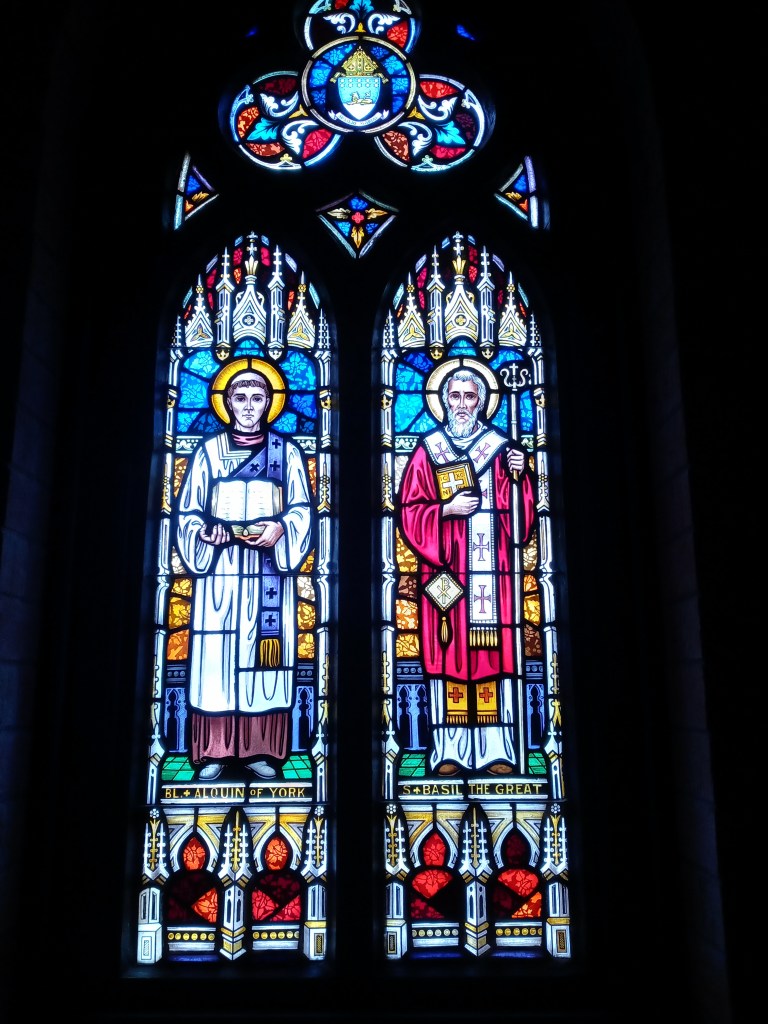
Let’s begin with the key point: Catholics do not worship saints. We honor or venerate saints, but we do not consider saints in heaven to be a kind of god or goddess that we worship.
Then why do we talk about praying to saints? In Latin, there are two words that can be translated into the English word “pray.” The first is latria—this refers to the adoration or worship that is proper to God alone. To God alone do we give latria. To offer latria to anything or anyone other than God is to break the first commandment—to offer God alone our worship. The second Latin word that can be translated as “pray” is dulia. This word refers to the honor and respect we offer to someone worthy of honor. It has the connotation of seeking assistance in some matter—such as the old English way of asking: “Pray, good sir, could you open the door for me?”
So latria—worship and adoration—is prayer we offer God. Dulia is giving honor to a saint. When we say we “pray” to a saint, it is shorthand for “asking a saint to pray with me or for me”—seeking mediation or assistance. In no way do we see a saint as having any divine power to do anything apart from God. Saints work miracles not through their own power, as Jesus Christ did, but by being an instrument of the power of God. So we dulia saints—asking for their intercession on our behalf.
But why? Why would we ask someone else to pray with or for us? Why not always go directly to God and bypass fellow members of the Body of Christ?
“We find rest in those we love, and we provide a resting place for those who love us.”
St. Bernard of Clairvaux
To answer that question, I think the best approach is to ask—what does God want us to do? Is there evidence that God asks us to use mediators (fellow humans) to intercede for us?
One doesn’t have to read too far into the Bible to see that God frequently commands His people to use mediators—there are famous mediators in the Old Testament: Moses, King David, the prophets. But this isn’t just an Old Testament thing. There are many stories of Jesus healing people because of someone else’s request. He commands us to intercede for each other—for forgiveness of sins, for healing, for salvation. He promises that we will do greater works than He did, in His name and with His power.
After Jesus’ ascension into heaven, the Apostles heal in Jesus’ name—both people who are not yet Christian (such as the healing of the crippled man by St. Peter) but also those who are Christian and who presumably prayed to Jesus on their own behalf as well (such as when St. Peter raised the disciple Tabitha who had gotten sick and died).
The key point here is that saints in Bible times and in later ages answer prayers through the power of God. An analogy might be a generous boss who handed each of his employees a credit card and authorized them to use it whenever they encountered someone in need. The receiver of a gift from an employee would be silly to say, “Oh no, I don’t want the gift from you, I want the boss to give it to me.” The gift did come from the boss, but through the hands of the employee. The gift of a miracle or an answered prayer always comes from God—always—whether mediated by a saint or not.
So, why would God make use of mediators so often? Why would He want us to seek the mediation of others? I want to share four reasons:
First reason: giving honor and veneration to saints by asking for their intercession strengthens the virtue of humility. And when we are humble, we are teachable! I think back to the time when I was in graduate school. I was writing a major paper and submitted a draft for review to several professors. One ripped my paper to shreds—critiquing my literature review, my presentation of the problem, and my plans for research. Ouch! It was devastating to me, of course. But after licking my wounded pride and considering his comments, I realized that his criticisms helped me improve my paper far more than the positive comments of other reviewers who basically said, “Good job, it looks fine.”
Now, I am not suggesting that when we ask a saint to intercede for us, they are going to rip us to shreds and criticize us like my professor did—but, we are admitting to ourselves and to God that we need help. That maybe, perhaps, saints in heaven have a deeper understanding and greater competence in spiritual matters than we do. That maybe, perhaps, we could learn a thing or two from someone who’s overcome similar challenges in their life. When we are humble, we can learn. We can grow. We can progress farther in the spiritual life. Asking for the help of a saint is a sign of humility—on our part as we confess our need. And on the part of the saint in heaven—who in the glory and greatness of the heavenly kingdom, will stoop to help me find my lost car keys!
Where humility abounds among members of the Body of Christ, the fire of the Holy Spirit blazes with vigor and power! And in the warmth of that fire, God is glorified, God unleashes His power!
Second reason: honoring and venerating saints unites us in visible, direct ways to the Mystical Body of Christ. We form one body, one life in Christ (see 1 Corinthians, chapter 12)—this is a great truth about faith in Jesus Christ, isn’t it! This One Body of Christ incorporates all who have put their faith in Jesus Christ—all over the world, in every age. The Holy Spirit, the soul of the Body of the Christ, unites us all—living here on earth and living in heaven—into one glorious Body. Talking to a saint living in heaven, therefore, and asking for their help is not really any different from asking a fellow believer living on earth for help.
In fact, because a saint is right now caught up in the power and glory and majesty of seeing God face to face, they are more eager and effective in their assistance. Just think about it—if you could allow God’s love to shine through you with perfect clarity and focused power, wouldn’t you rejoice in that capacity—especially if letting God’s love shine through you brought honor to God Himself? Wouldn’t you find it pure joy to exercise, to mediate, the love of God in your own unique way—perfectly reflecting the way God designed you? I think it would be similar to the joy a pole vaulter must feel as she soars over the bar, or to the exhilaration experienced by a skier going full tilt down a mountainside.
Third reason: God is Father to us all—and every parent wants to see his children love and respect one another. God designed each human being to be a unique, never-to-be-repeated manifestation of His love—a creation of unimaginable dignity and value. God also establishes us as brothers and sisters in the Family of God. It makes sense that He would be pleased when His children exercises the talents and gifts he gave us.
Parents find more pleasure and joy at having our children honored than in receiving honor ourselves. I remember once being at the retreat house at Mt. Angel Abbey in Oregon with my second son when he was in middle school. We were writing in our prayer journals—and both of us were using a set of calligraphy pens. A Benedictine monk happened to be passing by the big table and stopped to look over my son’s work. “That’s really good,” he commented, “I hope you keep up with calligraphy—you have a real talent for it.” I was so pleased that he had stopped to take notice of and recognize my son’s talent. Did I care that he didn’t say anything complimentary to me? No, not really. In honoring my son, I received a gift, too. We parents love our children so much that, when someone praises their character or talents, we find it a blessing to us as well. Where did that kind of love come from? It is a weak reflection of the love our heavenly Father has for all His children—God’s heart is filled with joy when we honor and love another one of His beloved children.
Fourth reason: Saints can help us progress on our own path to sainthood. God doesn’t want us to honor any saint—even a great and famous saint—in order to become a mere copy of them. Each person is destined to be a unique saint in the kingdom of God—but it would also be silly, short-sighted and very prideful to think we can learn nothing from one another. By watching, learning and internalizing the masterful ways of another, we further develop our own abilities.
“Don’t wait until tomorrow to begin becoming a saint.”
St. Therese of Lisieux
I recall the fun of preparing a meal with my mother and other members of my extended family. Surrounded by great cooks—some of whom had traveled extensively and picked up techniques from all over the world—my own cooking improved. Not as a competition, but through inspiration. I found myself achieving a higher level, taking more care and unleashing more effort, when I was cooking with those filled with a love and talent for cooking.
I think the same is true in our spiritual life: when we acquaint ourselves with those who have achieved spiritual greatness and moral excellence, we can be carried along to a higher level in our own lives. It’s part inspiration, part motivation, part reassurance. Again, we not trying to become a “copy” of another saint, but being surrounded by excellence is inspiring—I think about the basketball players who achieved greatness in their own right in part because they played with Michael Jordan.
“We are not like grains of saint, loose and separate and unconnected to each other, but, on the contrary, as human beings we are mutually related by natural bonds and, as Christians, by supernatural ties as well.”
St. Pius XII, Summi pontificatus, October 20, 1939
We’ve discussed how honoring saints is different from worshiping God—and we’ve considered four reasons why God wants us to seek the intercession of saints. So how can you honor saints in ways that advance your own walk with the Lord? First, take the time to learn about some of the saints, and then choose a few that can inspire you to achieve excellence. Second, ask for the intercession of your chosen heavenly helpers—and do so to honor the giver of all good gifts and the source of all goodness: God. Third, do everything you can to cooperate with God’s plan for you to become a saint—His deepest desire is for you to live with Him forever in heaven. He can’t wait for you to fully experience the joy that comes from being an instrument of God’s powerful love to those who seek your help. A joy you already have here on earth whenever you help someone—a little foretaste of heaven!
 Flourish Catholic