
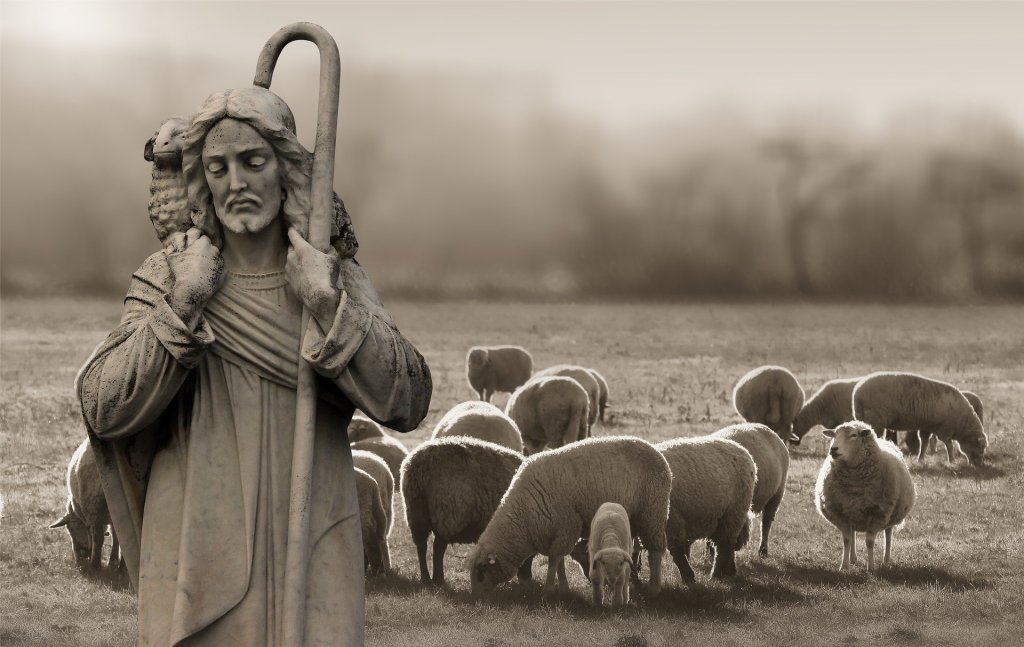
Good Shepherd Sunday invites us to muse about sheep. I know that the people of God have been referred to as “God’s Flock” since the Old Testament—my favorite Psalm, in fact, states it about as plainly as it could be stated: “Know that the Lord is God! It is he that made us, and we are his, we are his people, and the sheep of his pasture” (Psalm 100:3). Abel, the first to offer an acceptable sacrifice to God, was a shepherd. Abraham, Isaac and Jacob were shepherds. Moses tended his father-in-law’s flocks before being sent by God to shepherd his people out of Egypt. David was a shepherd, first of his father’s flocks and then of the nation of Israel. Many of the Psalms use images of sheep and shepherding when referring to God’s chosen people.
Why do we have to be compared to sheep, of all things! Why not majestic horses of God’s herd: full of vitality and spirit, courage and power? Why not loyal dogs, smart and obedient, working hard all day beside the Master? Why sheep? Sheep aren’t too bright. They panic easily and scatter with no strategy. They walk out of their enclosures, get lost, and don’t remember how to get home. They eat things that make them sick. They are subject to disease and injury and predators. They look alike, sound alike, smell alike—and, really, what’s to like about them?
It stings the pride a bit, doesn’t it? And then… I start thinking about how I actually behave. I have certainly wandered far from good pastures and gotten myself totally lost in sin—and needed my Good Shepherd to rescue me. I have listened to the scary “wolves” and storms that come up in every person’s life, then panicked and taken myself away from the only One who can truly save me. I’ve willingly consumed what has harmed me—devilish lies that sicken my soul and weaken my spirit. I recognize my weakness and vulnerability to the evil intentions of others. Well, I guess if the “baa” fits, I better join the flock.
God declares Himself to be our shepherd who will care for us, bind our wounds, give us all we need to thrive, and protect us from danger (Ezekiel 34:1-17). And then Jesus Christ, God’s Beloved Son, declares Himself to be the Good Shepherd—the one who will lay down His life for His flock (John 10:1-18). Jesus will care for us, lead us to safety, protect us and guide us to good pastures. He says His sheep know His voice—the sheep trust the voice of the Lord and follow Him wherever He leads. Jesus, the Good Shepherd, will not abandon us, will offer Himself for our sakes.
Growing up in the Willamette Valley in Oregon, I observed sheep being turned loose in huge pastures alongside Interstate 5 every winter. A big semi-trailer full of sheep would back into a pasture, let them all out, then leave them alone. They ate grass, got rained on, some died and fed the Bald Eagles that learned to winter in the Valley and feast on carrion. I never saw a shepherd. I had no idea how sheep were actually shepherded.
Then I learned about what shepherds were like in Bible times. How they would spend all their time with their flock. How shepherds walk ahead of their sheep and call to them—and the sheep trot along behind, trusting the shepherd to bring them to a place where they’ll find water and food. The shepherd’s staff, I learned, was not to strike the sheep, but to strike the predator. The staff guided a sheep headed toward danger or hooked one who had fallen in a ditch. The shepherd knew the individual members of his flock—those bewilderingly similar “woolies” apparently can be told apart—and knew the quirks, temperament and needs of each one. The shepherd was responsible for the sheep, and a good shepherd would place himself between his flock and any danger that appeared. Sheep, it turns out, have one amazing quality: they quickly learn the voice, the mannerisms, the appearance of their trusted shepherd. And they are amazingly loyal.
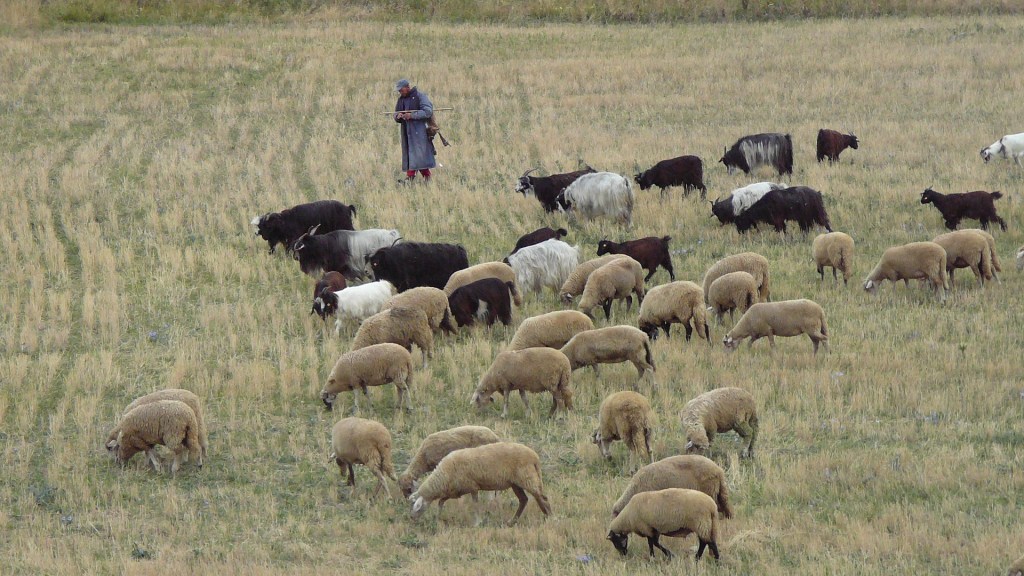
When I get off my “high horse” and embrace my inner “sheepiness,” I’m ready to follow my Shepherd. Do I know His voice? How? Do I spend time in the Bible, learning the sound, the cadence, the quality of my Shepherd’s voice? Do I listen for His voice in my heart and mind, or am I so distracted with the wolves in sheep’s clothing that clamor for my attention that I hardly every hear my own Shepherd? Do I hang out with other sheep and follow the wise ones who stay close to the Shepherd? Do I run to my Shepherd when danger threatens, or do I lose my head and run away, into greater dangers? Do I call out for help when I get lost or simply wander further away in my stubbornness? Do I listen to the shepherds whom Jesus has placed in authority over the flock or do I pridefully refuse any attempt to admonish, instruct or correct me?
Good Shepherd Sunday celebrates the One Shepherd who cares for each member of His flock—and who has given us shepherds to care for us until His return. Yet these shepherds sometimes turn out to be wolves who endanger the flock and take advantage of their hapless charges. Sometimes the shepherds are cowardly, mercenary—only taking on the job for their own gain. When troubles come and dangers threaten, they abandon the sheep and save their own hides. If we have to be sheep, can’t we at least be assured of good shepherds?
Even if false shepherds can mislead even the most attentive of us, at least we can recognize the predators, the demons who tempt us away from God. Unlike our true Shepherd, the evil one drives us from behind. For if he got in front of us to try to lead us, we would recognize the ugliness and horror we faced and run away. If you feel “driven,” be aware that that’s certainly not how God shepherds His people. Bad shepherds, false shepherds, predators—we face them all. And, let’s face it, we’re sheep for gosh sakes! What can we do about it?
God in His goodness, will bring justice to His flock—but in His time and in His way. God allows the flock to experience these troubles in order to bring about a greater good—a good we might not be able to discern this side of heaven. But I trust in my Shepherd. And the truth is, sheep are pretty wily. They’re hard to drive and easy to lead. They might not be quite as helpless as the predators hope them to be.
Throughout our history as God’s flock, I also recognize that when shepherds turn out to be wolves or mercenaries, God brings forward new shepherds to take their place. Shepherds who seek only to serve, who are filled with compassionate and courageous love. Sometimes these good shepherds aren’t as popular, might not appear as attractive or interesting, they’re usually not “influencers” or “schmoozers.” They simply shepherd, they don’t seek attention. They smell like the sheep (thank you for that one, Pope Francis!). Sheep in their care grow sleek and fit, healthy and vibrant—ready for that long journey to the good pastures of Heaven.
On Good Shepherd Sunday (or whenever you can), spend time in God’s Word and rejoice in the One who shepherds His people. Place your trust in the Shepherd and learn to recognize His voice—seek, listen, and respond to it. He will call. He will seek you. He will protect you and never allow you to remain lost and endangered. Next time you attend Mass, behold the Lamb of God who takes away the sin of the world—behold Him who comes to you in the Eucharist and shepherds your soul to good pastures, to refreshment and delight. Run to the shepherd as you go forward for Holy Communion: allow Him to enfold you in His loving care as you enfold Him in the consecrated host given to you.
Pray also for those who shepherd the flock until the Lord’s return. Pray for our Pope, our Bishops, our Priests and Deacons. Pray for those who lead us to spiritual growth, and for those who challenge us to serve and care for the least among us. Pray for those who teach, heal, govern and create. Pray, especially, for the most unsung shepherds of all—parents who are striving to shepherd the flock entrusted to them through a world filled with wolves and bad shepherds.
God will vindicate. God will restore. God will triumph. Through love. “Behold, the Lord God comes with might, and his arm rules for him; … He will feed his flock like a shepherd, he will gather the lambs in his arms, he will carry them in his bosom, and gently lead those that are with young” (Isaiah 40:10-11).
 Flourish Catholic