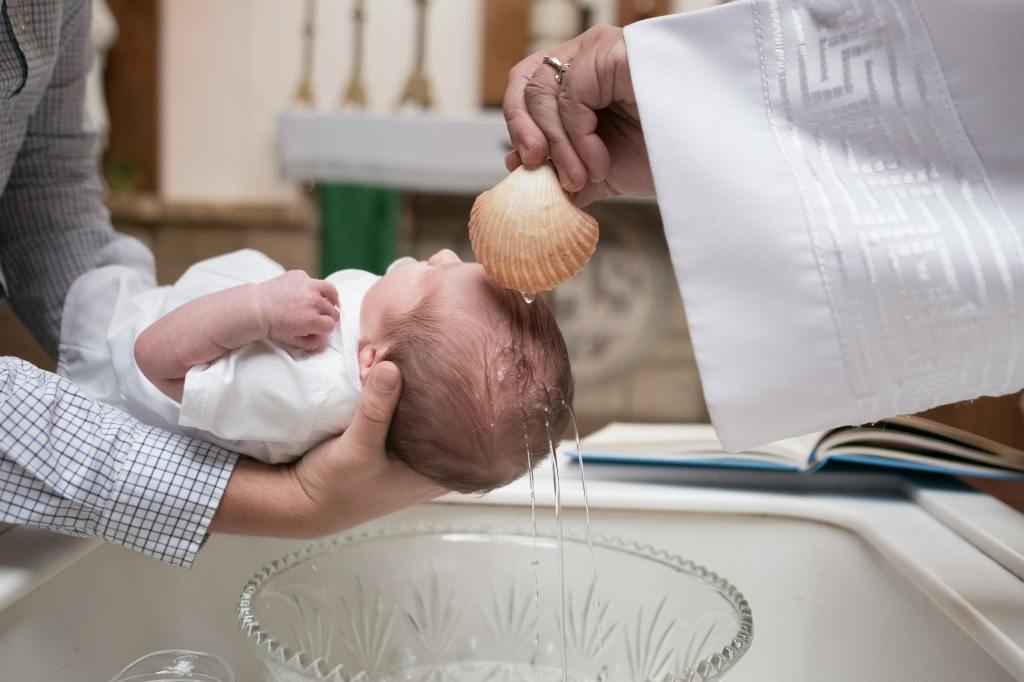
For most non-Catholic Christians, Baptism is seen as a step one takes after confessing Jesus Christ as their personal Lord and Savior—a step that reflects a conversion to the Gospel and a choice to live according to the faith one can now profess. If that’s what Baptism is, then infant Baptism doesn’t make sense. How can an infant know Christ and choose Him? How can an infant request Baptism or pledge to live as a Christian? Baptizing infants reflects a different understanding of what Baptism is in 3 respects: first, regarding the nature of grace; second, the nature of the Church; and third, how Baptism changes us.
Baptism is the foundation of all the Sacraments. No other Sacrament can be received by a Christian until they have been Baptized. Baptism is the gateway to the Christian life, and it profoundly and permanently alters our very identity. Baptism is the first Sacramental encounter we experience with the God who has loved us into being and can’t wait to begin a relationship with us that will culminate in the glory of heaven.
Baptism begins our new life in Christ. The newly baptized are referred to as “neophytes” from the Greek term for new life. Baptism changes who we are, not just what we do or what resources we can use to accomplish our goals. Baptism definitively changes us because we now belong to our Creator as His beloved child, not just as His beloved handiwork. Baptism changes us because we are united, mystically and spiritually and truly, with the death and resurrection of Jesus Christ. We enter the tomb with Him so that we can rise to a new life (see Romans 6:3-5)—touched forever by the same power that raised Jesus Christ from the dead. We receive the very life of God poured into our souls and bodies so that we become “little Christs”—Christians! When God the Father looks at a Baptized Christian, the “Son” gets in His eyes! The Father sees a Person united with His Son, filled with His Holy Spirit—and the Father loves us as He loves His Only-Begotten Son. That love changes us forever and eternally.
“Rising from the waters of the baptismal font, every Christian hears again the voice that was once heard on the banks of the Jordan River: ‘You are my beloved … with you I am well pleased’ (Lk 3:22).”
St. John Paul II (Apostolic Exhortation, Christifideles laici, II, Dec. 30, 1988)
Can anyone truthfully say they deserve to be Baptized and that they have earned these graces from God? Of course not. We all approach the Sacraments as grateful children, not as workers owed their wages or as thieves/con-men seeking to take what is not offered them. Children do not stop to fuss about their worthiness when offered a gift—children just eagerly and gratefully receive! They understand that love prompts the giver to give—and that there is no shame in receiving what one cannot pay for or what one does not deserve. God is our loving Father who is eager to give His children all that they need to enter heaven. God’s gifts are offered for the sake of love—not out of cold calculations about who is most worthy or most useful or most demanding. Our response is to receive them and to give our consent to what they can unleash in us.
Sacraments are powers that come forth from God, but the effect they have in our lives is not automatic—they don’t work like vaccinations that protect us from a disease regardless of whether we desire it or not. Sacraments require our cooperation and free consent—because God is seeking to form us into good children, not useful robots or good pets. From our Catholic perspective, Sacraments in the life of the Christian are the actions of God that initiate movement for us, that give us the “push” needed to travel along God’s narrow path. We cooperate with these applications of spiritual energy—directing our movement and reducing friction—so as to make forward progress. God’s energy moves us—but for most of us, He does not simply pick us up and put us in heaven (I suppose that’s one way to think about the salvation experienced by the souls of infants). For most humans, God wants us to develop, over a lifetime, the capacities to receive His energy and translate it into motion. From the Catholic perspective, conversion is more like the lengthy voyage taken by passengers on the Starship Enterprise rather than the instantaneous trip taken in the “transporter beam.”
Catholics see conversion as a lifelong process: an ever-deepening and ever-widening response to God’s love. Over our lifetime, we allow God’s love to touch and transform every single part of us until we grow into the new life God began at Baptism—the “new man” made in the image of His Only-Begotten Son, Jesus Christ. The conversion of the Sacrament of Baptism, therefore, is the initiating moment, the time that God begins the life of grace in our souls—it does not represent our lifetime’s response to God’s initiative. That response is worked out over the lifetime God gives us. Baptism begins our life of grace—and that beginning is totally and completely a product of God’s grace.
Infant Baptism reflects this Catholic understanding of the nature of grace. We cannot earn God’s grace. We can never deserve it or pay for it. God’s grace is His initiative—a gift of our unearned participation in the very life of God. When we bring a baby forward to be baptized, we are confessing this fundamental truth: we confess that God has loved this child into being and is calling him/her to belong to His family before they can do anything to “earn” it or prove themselves “worthy.” Parents act in hope-filled faith, recognizing and responding to God’s invitation to their child before their child is even aware of it.
But it’s not just true for unaware, incapable babies, is it! We are all, compared to the magnificence and intelligence of God, like babies. Born into the family of God through Baptism, we open our mouths and find nourishment; we cry out and find comfort; we reach out and find loving arms to hold us. If we waited to care for our infants until they could choose to ask for it, what baby would survive? Aren’t we all in the same situation in our spiritual life? We might like to think we’re in charge, fully cognizant of our needs and how to fulfill them, rationally choosing what is best for us, but we’re simply not. We are all like infants in need of spiritual nourishment—and the most saintly among us, who seem so far advanced and mature in their spirituality, are usually the most eager to admit to this state!
Infant baptism, therefore, makes sense according to our understanding of the nature of grace. Infant baptism also accurately reflects our understanding of the nature of the Church. The Church is the family of God—the brothers and sisters of Jesus Christ united in His mystical Body. This family of God is rooted in God’s Chosen People, the Jews. All are brought into the covenant God initiated with Abraham by Jesus Christ. He commanded His apostles to go out to all the nations, preaching and baptizing (Mt 28:19). All peoples, all nations, all tribes were finally able to join Israel in the worship of God in spirit and truth. All peoples, all nations, all tribes are invited to climb God’s holy mountain and enter His Kingdom.
Being more like a family than a club, organization or honorary society, joining the Church is more like getting born into a family than “signing up” or being accepted by a membership committee. When babies are born, they are in the family—they are full members and accepted at once. No grandparent comments, “Well, let’s wait and see how that little baby develops before we accept him into the family.” No! The baby’s in by virtue of his or her parents. We accept “takers” and “givers” in our families—and part of the job of every parent is to help their children become givers, not just takers. But a child who can only “take” is just as much a part of the family as the members who shoulder the burden of extra “giving.” Love, not economic reciprocity or rational calculation of profit, is the foundation of family life.
New “baby” Christians are accepted in the same way. We don’t wait to make sure they’ll contribute monetarily or talent-wise to the Church before we bring them into the family. We don’t even wait until they can properly explain or defend our basic Christian beliefs. By virtue of their Christian parents, they’re in! When a baby is born into a Christian home, they are already members of the “ecclesia domestica”: the domestic church in the home. In the domestic church, babies are already introduced to the Christian way of life and live within its parameters. The Church recognizes the validity of the Christian home and the nearly irreplaceable effect on children born into one. For these reasons, baptizing the infant born into a Christian home is a recognition of the Body of Christ already present within, and guiding, the family.
Because infant baptism depends upon the vitality of the domestic church, a baby can be baptized only when the priest/deacon has assurance that the child will be raised as a Catholic-Christian. Parents and godparents take solemn vows within the Rite of Baptism (the ceremony used for a Baptism) regarding their role: if they cannot testify that they are ready and able to raise their child in the faith, then the baptism of the baby cannot happen. This is not intended as a bothersome “hoop” to jump through—this requirement reflects the very foundations of our understanding of Baptism as the beginning of a solemn covenant relationship with God.
Covenants are lifelong relationships based on mutual promises and the giving of self to one another. Covenants are made by free consent and require active participation. The baptismal covenant is made for the child by the parents because their life as a Christian is the center, the foundation, of everything they are and do. There is no way a child raised in a truly Christian home would not be involved in the family’s covenant with Christ—it would be like saying that the children of a community living high in the mountains could exist in that environment without also developing their parent’s lung capacity to breathe and work in the thin atmosphere. Our children depend upon us for the most foundational building blocks of their own life: certainly in terms of the DNA we pass on to them, but also in terms of the language we speak, the culture we pass on, and so much more. Faith in Jesus Christ is not just one additional attribute—it is the ground beneath them all!
This isn’t a new idea for the Catholic faithful. Household members of new believers were baptized by both St. Peter (Acts 10:44-48) and St. Paul (Acts 16:31-33)—presumably this included children. Why could they include family members after the head of the household professed faith in Jesus Christ? Because all living within the house would be impacted by the Christian life of its leaders. That’s the vision. That’s the ideal. If we are truly living out the radical nature of conversion, we will experience the same truth—no one in our close sphere of relationships is unaffected by our Christian life, even if they choose later not to accept it.
In a Christian home, the grace received at Baptism is given the space, time and nourishment to flourish. Baptismal grace, like the acorn of the oak tree, will take root, mature and grow throughout a lifetime. The life of the oak remains one life from acorn to tremendous tree—the manifestation and capacities of its life change as it matures. The same is true of our baptismal faith. By baptizing infants, the Church is not proclaiming that the child has no role in their faith and that their salvation is assured from that point on (it is assured, however, until the person freely chooses to reject God through mortal sin). They are given the seed of faith—everything they need is given them by God through the mediation of parents and a Church family—and then they are asked to take that seed, guard it, nurture it and guide its growth throughout their lifetime.
Any baptized person can lose the effects of Baptismal grace by being in a state of deadly (mortal) sin—by rejecting the love of God and exalting the love of self. Baptism promises us a great gift: eternal life with God which begins as we strive to be Jesus’ disciples here on earth. But we can choose to leave this gift alone, unopened and unused. We could even choose to return the gift in some definitive rejection not only of the gift but of the Giver Himself. Opening and learning how to use the gift of Baptismal grace takes a very long time for most of us—with false starts, backward and sideways interruptions, and periods of inactivity in our life of faith. But the gift remains available to us this side of eternity.
Every Easter, we are asked to solemnly renew our Baptismal promises—to state, once again, that the grounding and center of our lives is the life of faith. Our response to God’s personal, everlasting and life-giving love is necessary—not just once, but every day, every moment. Infant baptism utterly changes our nature and our destiny, but God then invites our cooperation and hard work for the rest of our lifetime. As St. Augustine explained, “God created you without your consent, but He will not save you without your consent.”
How can the Christian family, the Body of Christ, make it more possible for its new members to offer this consent? By sharing with them the gift of God’s grace that comes through the Sacraments Jesus entrusted to the Church. Jesus gave the Apostles and their successors the authority to share His life with others in a unique, Sacramental way. These Sacramental encounters with the life and love of Jesus Christ are powerful gifts—gifts we are eager to share with those who are ready and able to make use of them. All of fallen humanity needs supernatural grace in order to have a relationship with God—sin gets in the way, clouds our vision, reduces our awareness and increases our resistance. We need God’s help even to get to know Him—all depends on grace!
This understanding of the human person gives us the final reason why the Catholic Church baptizes infants: we need God’s grace at the very outset of our life of faith, we are totally dependent upon God to cleanse us of our sin and fill us with His love. We humans are born into a fallen world. We inherit the effects of Original Sin through our human nature. Original Sin is a state into which we are born—it is not a personal sin for which we are responsible. But original sin still affects us and limits our capacity to come to know, love and serve God in this life and so enter heaven to live with Him forever. In fact, without God’s grace, the life of a Christian is impossible!
Baptizing infants is a reasonable response to this dilemma: we want our children to come to have a personal relationship with Jesus Christ and His Body, the Church, but we know that every human person needs God’s grace to respond to God’s initiative of love. Baptism is a means instituted by God Himself to remove the harmful effects of Original Sin on our souls and to fill us with the supernatural graces—the virtues of faith, hope and love—that enable us to respond to God’s initiative. As Christian parents, we are not “forcing” our children to choose the Christian way of life by Baptizing them, we are making it possible! We are allowing God to eliminate roadblocks and provide signposts at the earliest point in our child’s journey of faith.
We help our children in their life’s journey in all sorts of ways: we do whatever we need to do to keep them healthy, safe and feeling loved. We speak to them way before they can talk, and we foster their intellectual development through our constant interactions. We provide them with boundaries and guidance to navigate social life—even protecting our other children from merciless toddlers! All these efforts and actions are natural for parents to provide for their children. We can’t possibly wait for our children to ask for these things or agree that they need them—they need them before they know they need them. Well, faith is in that category, too!
Christian parents don’t baptize their children solely to remove the effects of Original Sin from their souls—which is a great blessing of Baptism, don’t misunderstand me! But the purpose of removing Original Sin is not to give our children a “clean slate,” but to allow God to fill their souls with His very life. God cleans the vessel in order to fill it with something—not to leave it empty and sterile. The blessings and fruit that can come from having the gift of God’s grace from the very start of one’s life are immeasurable. What an amazing gift from God we parents can accept on behalf of our children—and how amazing it is that God invites us to be His mediators and shepherds of the life He has called into existence! Whether we are parents of biological children or become parents in the spiritual order as godparents, sponsors or mentors, assisting in the faith journey of another human being is one of the greatest blessings God can give us. Let us embrace the role, be thankful for it, and assume the responsibility with courageous joy!
This all became so real to me as my husband and I stood before God and the Church with each of my 5 children at their Baptisms. I understood the enormity of the commitment I was making—to God and to my child. I consider those moments some of the most powerful and influential of my entire life—I assisted with a human soul being reborn as a child of God. Very little in anyone’s life can compare with that!
I also had an experience in 2013 that drove home the importance of my own baptism as an infant. During the Holy Year of Faith, I studied Pope Benedict XVI’s letter about it—and once I learned of his hope that each person would find a way to honor and celebrate their own baptism, I knew what God wanted me to do.
So in the Summer of 2013, I walked a pilgrimage to the parish where I was baptized—90 miles, stopping each night to stay in a parish on the way. I began my pilgrimage in Eugene, Oregon at St. Paul Parish on the feast of St. Peter and St. Paul (June 29), and I finished at St. Joseph Parish in Salem on Independence Day. I renewed my baptismal vows after the noon Mass on July 5. My pilgrimage was a very significant moment in my life.
As I walked the second day toward the little town of Monroe, I saw a huge sprinkler watering crops in a field alongside the road. It was a blistering hot summer day in the Willamette Valley, and I thought about how wonderful it would feel to get some of the cool water on me. So I crossed the road and stood in a wet patch of gravel and waited for the sprinkler to make its way back around. As the water hit me, I staggered back from the force and shock of the drenching I received! I had not counted on the enormous difference in water pressure and volume of an impact-head sprinkler in a farmer’s field compared to the one in my backyard!
I laughed at myself for my own foolishness and enjoyed the water pouring off my hat and back and sides. In my journal that night I reflected on how that experience was a good illustration of my whole pilgrimage. Here I was, seeking some nice, safe, controllable and pleasant way to celebrate my baptism (to get a bit of water to cool me off), and God was aiming a firehose at me! This, to me, is the difference between how we think of the effect of baptism as opposed to what God is really doing for us.
After walking for miles into Salem on a street named “Liberty” on Independence Day, I was exhausted and footsore. I made my way through downtown and saw the doors of St. Joseph ahead of me. As I opened those huge doors and walked into the dark church, I could sense the angels rejoicing with me: “You were born here! Here is where you were given freedom as a daughter of God!” I knelt in thanksgiving and rejoiced in the journey I had taken—a journey to the heart of my life, through the heart of the Valley.
As I stood before the priest and renewed the vows made for me by my parents on November 7, 1965, I understood better the enormity of the change God had made in my life. I knew that all my faults and sins and moments where I had failed to uphold those Baptismal promises could not keep me from God, since I had repented, confessed them and been forgiven. I knew that the times when I strove with all my might to live up to those promises came from the grace of God and from His overwhelming love. Starting from the moment of my Baptism (but, thank God, not ending there!) I was sought, fought for, rescued and healed—because He loves me and for no other reason. I, who had assisted through my 3 decades of parish ministry in the baptisms of hundreds of infants, children and adults, stood before the Lord as one soul: one naked, vulnerable, needy soul. One person, with no works that could earn God’s love and with no abilities that He needed to accomplish His plan—just me: beloved, desired, seduced and won over by my Lord. And I committed to the covenant God made with me so long ago. I spoke my “I do’s” with joy and conviction and peace—I was home, with my God, in the church where I was born unto eternal life and all was well.
When the priest sprinkled me with holy water, it felt as powerful to my soul as that sprinkler had felt on my body on the side of the road! God’s waters of new birth are a constant waterfall of love—never exhausted, full of energy, always renewed within our hearts. It is true! The love of God is poured out into our hearts through the Holy Spirit (Romans 5:5). To God be the glory, to God be the praise—what wondrous love He shows us!
 Flourish Catholic