At every Mass, we exchange four greetings: at the beginning of Mass, before the Gospel is proclaimed; during the opening dialogue of the Eucharistic Prayer and before the Dismissal. Every Mass also has five processions: the Entrance Procession, the Procession of the Gospel, the Procession of the Gifts, the Procession of the Communicants and the Closing Procession. Why so many? What is the point of this repetition?
Repetition serves those who worship. God doesn’t need repetition, but humans do. Humans learn through repetition. Humans “hammer home” in their heads and hearts what is most critical and foundational by repetition. We find comfort and joy in repetition—just observe the way children develop bedtime rituals that require the same storybooks to be read every night! Think of the joyous and affirming repetition of lovemaking within a healthy marriage. Repetition helps us focus on what is most important or central in what we are experiencing. We look for meaning by searching for repetition—in art, in nature, in our life experiences. Similar to the chorus of a song, the four greetings and five processions of Mass signal a key message—this is important! Greetings remind us of who we are and Who is with us. Processions remind us of what we are about and where we are going.
Each formal greeting begins with the priest or deacon declaring, “The Lord be with you.” Then we respond, “And with your spirit.” The greeting at the beginning of Mass can be expanded to use the words from St. Paul’s letter to the Galatians: “The grace of our Lord Jesus Christ, and the love of God, and the communion of the Holy Spirit be with you all.” Our response, whether the greeting is brief or expanded, is the same: “And with your spirit.” Our response acknowledges the function or role of the priest. He is not representing himself when greeting us at Mass, as might happen if we met our pastor running errands about town. The priest is greeting us in the person of Christ, as the presider of God’s family gathered to celebrate a Sacrament. We state this in our response “and with your spirit”—may God fill you with His Spirit so that you can properly and completely fulfill your role. The priest, in the spirit of Christ, comes to serve and guide the flock of God. We recognize this and command him (respectfully of course), to play the priest—to fulfill his ministry.
The greetings of Mass also say something very important about every person in attendance. Our blessing and prayers are needed by the presider. When the congregation is present, the priest doesn’t offer the Mass on his own. We the faithful offer the Mass as well. As baptized members of the Church, we exercise Christ’s priestly mission to intercede on behalf of others and to offer sacrifice. The Church’s ministerial priesthood is at the service of the “kingdom priesthood” of all the believers. Our participation in returning the greeting reminds us our dignity and power as children of God. We are members of the Body of Christ, recipients of gift and grace for the good of the Body. We are essential. We are irreplaceable. We are integral. We are eternal.
Each of the greetings come at a critical point of the Mass—and each greeting reminds us of our identity and destiny as a repeating refrain, a chorus, in this great song of worship. We exchange a greeting as Mass begins, rejoicing that God has summoned us together to worship and serve Him. We are eager to give ourselves to God and for God to give Himself to us. This formal greeting serves to remind us that we are participating in a very distinctive, very essential form of communication at Mass—communicating not just words, but life and love. It is an acknowledgement of the holy work of the Mass—of the distinctive and powerful actions taking place in the Mass. Actions in which we participate, not simply observe.
We exchange a second formal greeting as we prepare to hear the very words spoken by the Word of God, Jesus Christ. This is the one greeting during the Mass that can be said by a deacon, not a priest. If a deacon is serving at Mass, he reads the Gospel—this is his special ministry through his ordination. At this point in the Mass, we are ready to receive the Gospel, the Good News, of Jesus Christ. We stand to exchange the greeting and to hear the Gospel proclaimed. This is what we stand for. These words require an active response. These words we are about to hear were spoken by our Lord and Master, and so we stand with attentiveness and respect.
The third greeting at Mass happens at the beginning of the Eucharistic Prayer, the high point of the Mass. We join the actual moment when Christ offered Himself for our sake to the Father, and we partake of the memorial meal that Christ gave us as a sign of His sacrifice. The formal greeting during the Opening Dialogue of the Eucharistic Prayer reminds us that we are truly participating in this sacrifice of Christ. We can add nothing to the efficacy of Jesus’ Once-for-all Sacrifice, but the humble Lord of the universe welcomes our participation and re-presentation of it. In fact, He commanded us to repeat the memorial of His Sacrifice until His return in glory. So we gather to worship and to unite ourselves to His one offering. We also unite ourselves with the entire Church—those worshiping God in the perfection of heaven, those seeking His healing in purgatory, and those of us still in the world but not of it. The priest, in the Person of Jesus Christ, brings us to the moment of Calvary, anticipated at the Last Supper.
The final greeting of the Mass happens right before we are dismissed. The priest’s sacramental vocation is to serve the community of believers, especially in the celebration of the Sacraments. The priest then turns these Sacred Mysteries over to us—we depart the church as living Gospels and living Tabernacles. It is our task, as lay people, to bring Jesus to the world. The priest greets us and receives our response to acknowledge this “transfer of power” at the end of Mass. We are sent forth to preach the Gospel: by our words, actions and attitudes. We understand that, by virtue of our participation in the Mass, we are not our own—we have been purchased at the price of the Blood poured out for us. We pledge to live in obedience to the command of Jesus Christ to go into all the world and proclaim the Gospel. The greetings at Mass give us a chance to pause, to return to this refrain of truth that runs through the whole Mass: we are God’s beloved come to worship Him in spirit and truth.
The four greetings find their counterpart in the five processions—there is a beautiful rhythm in the Mass where we move from procession to greeting. Why so many processions? For a Christian, life on this earth is best defined as a pilgrimage. We are journeying to our true home, to our Father’s house. Our citizenship is in heaven, and this life is a life in exile—and marked as a journey home to the Father’s heart. A pilgrimage requires the pilgrim to journey on the correct path. The processions at Mass help us comprehend the nature of the choices we need to make as we journey through this time on earth.
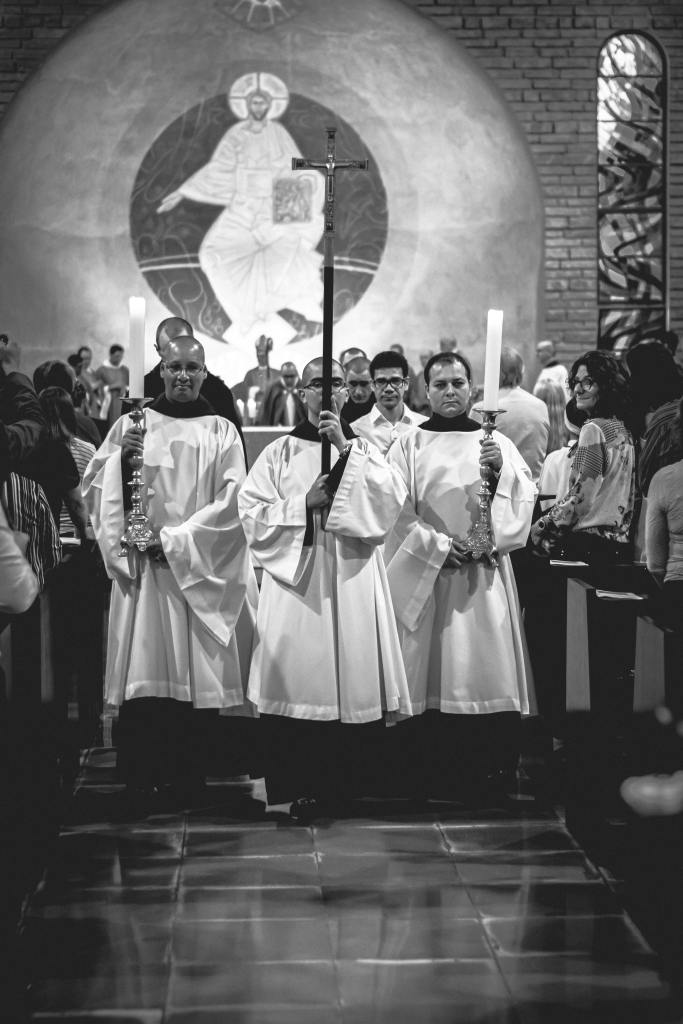
Mass begins with an Entrance Procession. The ministers and the Presider process to the Sanctuary, following the crucifix and bringing forward the Book of the Gospels. We follow our crucified Lord and we hang on his every word. We begin Mass with this reminder of Who we follow—and the Greeting that follows reminds us of our essential work in the Body of Christ. We are called, by our Master, to take up our cross and follow Him. No matter that the world sees the cross as foolishness; we know it to reveal the saving power and victory of God over sin and death. We humbly and proudly fall in line behind our crucified Savior and accept the cross He asks us to bear as well.
Later in the Mass, the Book of the Gospels is carried in procession before the reading of the Gospel. We treat the Gospels with such reverence because they contain the words of everlasting life. We are not a religion of the book; we do not worship the Bible. The Bible is not God, but it contains and expresses God’s word. In fact, we say that every word in the Bible points to the one Word of God, Jesus Christ. It is Jesus whom we worship. The procession of the Gospel reminds us that we will stay on the right path on our heavenward journey if we choose to live by every word that comes forth from the mouth of God. For His word is living and effective, it will not return to the Lord until is has accomplished its purpose.
As the Liturgy of the Eucharist begins, the gifts of bread and wine are brought in procession to the altar. Those gifts are symbolic of all the resources God has given us in His beautiful creation. They also evoke all the efforts and ingenuity we humans use to craft the things we need from God’s creation. We bring up bread and wine, not wheat and grapes. We have taken God’s gifts (which represent all of creation) and transformed them by our own efforts: crushing grain and grape, mixing ingredients, and coming up with something new. These offerings represent the union of God and human effort in sustaining life on earth and anticipating our life in heaven.
After the gifts are received and God is thanked, we are offered a greeting by the priest in the Opening Dialogue of the Eucharistic Prayer: The Lord be with you. And with your spirit. Lift up your hearts. We lift them up to the Lord. Let us give God thanks and praise. It is right and just. As the high point of the Mass commences, the Eucharistic Prayer and the Miracle of the Eucharist, our dialogue helps us get in the right frame of mind. We are at Mass to worship God, to offer sacrifice, and to receive grace. We find our true identity through this act of worship. God doesn’t need our praise as if He were some insecure ruler. When we worship God, He blesses us and elevates us so that we become Who we worship.
The movement from procession to greeting gives the Mass a beautiful rhythm—evoking a symphony’s repeating refrain that highlights the central theme of the music. Our processions and greetings speak to us of the essential work we have as humans: we are designed for worship, we are destined for heaven. God created us and redeemed us and considers us worthy of being in a relationship with Him—a relationship based on covenant love, not servile fear or greedy exchanges of goods. The act of processing reminds us of the journey of life; we are “pilgrims” on this earth. We are moving toward our true home of heaven—and each procession at Mass speaks about the form and focus our journey takes. We journey with God’s Son as our guide—hence we follow the crucifix and process the Gospels. We journey to heaven and are given everything we need to sustain our journey—hence the procession of gifts to the altar.
The rhythm of procession and greeting is interrupted at the high point of Mass—our procession forward to receive Holy Communion is not associated with a greeting from the priest. Why would it be? We are about to be greeted by Jesus Himself, present in the consecrated Host! This procession is best described with imagery from the wedding. The procession of the communicant to receive the Eucharist is the procession of the bride coming forward to meet her bridegroom. The communion that happens in the Eucharist is the highest form of intimacy and the best expression of true love—the spiritual embodiment that the marital embrace prefigures. Our procession offers us the opportunity to reflect, to prepare, to consent to this union with our Beloved. He waits for us, with passionate and longing love, as He watches His beloved bride come forward to meet Him. This procession anticipates, as no other procession at Mass does, death’s final journey to the wedding feast of heaven.
As Mass concludes, the greeting is again associated with a final procession. But the final procession does not simply involve the priest and ministers leaving the sanctuary. The procession continues while we move out of the church and into the world—into “mission territory.” We are dismissed from Mass to announce God’s victory, to conquer through love. Actually, we don’t really process at the end of Mass: this is more akin to the dismissal of troops for spiritual battle and conquest!
We go forth from the Mass filled with the Presence of Jesus Christ—ready and eager to conquer through the inexorable power of love, by the weapons of the Spirit. We are dismissed into a world that is enemy territory, fallen and wounded and dying. We seek out the lost, the rejected, and the marginalized. We offer words of comfort and peace. We offer actions of mercy and compassion. We listen with care and we speak with wisdom. In all the trials and challenges we face, we conquer through the love of Jesus Christ—a love that no one or no thing can take from us. With that knowledge, the greetings and processions at Mass are translated into the language of our everyday lives. We speak with the authority of one baptized into the priesthood of Christ, and we declare that the Lord is with us. We process through difficult situations and even to the very gates of hell, assured of victory as we carry the love of Christ made real to us in word and Sacrament.
In the four greetings at Mass, we proclaim four truths about our identity as Christians: we belong as favored children of God; we receive the one Word of God, our Savior Jesus Christ; we give ourselves to God in worship; and we are sent on mission as Jesus’ disciples. In the processions at Mass, we make five assertions about our life’s journey: we will take up our cross and follow Jesus; we will live by every word that comes from the mouth of God; we will offer the gifts we have been given back to the Giver of all gifts; we will live no longer our own life but the life of Christ living in us; and we will spend our lives obeying and serving Christ alone.
An experience I had with the dentist’s chair illustrates how our everyday lives are punctuated by the lessons of these greetings and processions. In college, I needed my wisdom teeth removed, and being a poor college student, I chose the cheaper route without general anesthesia. Terrible idea! The experience traumatized me so badly that I couldn’t drag myself to the dentist even for regular cleaning for years after. Finally, God intervened. I cracked a tooth. I had to go to the dentist. My husband called his dentist’s office and they got me right in. It was only the pain in my mouth that compelled me to walk through the door.
They greeted me kindly and compassionately. After getting settled into the dentist’s chair and having received the numbing shot for the procedure, the hygienist walked out of the room to check on another patient. I sat there, with that stupid bib on my chest and my hands gripping the chair, and a tear rolled down my cheek. “I am so sorry, Lord,” I prayed “I am such a coward. You have saints who were so brave they could face horrible tortures to honor you. And here I am in the dentist’s chair terrified, and it’s for my own good. I am sorry I have failed you.” I bowed my head and felt so dejected and demoralized. Then I heard the Lord whisper to my heart, “Don’t you know that the shadow of my cross reaches out right now to you as well? My cross is not just for those moments you consider huge and heroic. I am here with you.” I leaned back in the chair, and I let my breath out and relaxed. It seemed as if I was leaning back into the arms of Jesus. My fear left me right then, and I haven’t been afraid of the dentist since.
A few years later, it was time to bring our second son to the dentist for his first cleaning. My kindergartner was a sweet, shy boy. Our hygienist was effervescent and outgoing to the extreme. Her animated and loud greeting terrified my little guy, and she saw him shrinking away from her. She trained her lovely smile and bright eyes on me. “Why don’t you hop into the chair first, Mom, and then you can hold Jacob in your lap?” I climbed into the dentists’ chair and snuggled Jacob onto my lap. I felt him relax and press against me. As the hygienist made the chair recline, my own experience with my cracked tooth came back to me with a delightful shock of recognition. Years ago, that chair had become Jesus holding me. In the same way, I now held my son. Jesus had brought me healing and peace—and now I could bring Jesus to my son. Life in Christ is such a sweet blessing of grace upon grace!
Getting to that dentist’s chair and finding healing from my fears was one way I brought the processions and greetings from Mass into my life. I moved into a space of my fears and I followed the victory of Christ’s crucifix into my heart. I was greeted by the Lord Himself as I reached out to Him in prayer, and I spoke that greeting to my son through the way I held him and loved him as I had been loved. I had been recognized and honored, nourished and healed, and sent forth on mission.
Our daily lives give us innumerable times to enact the processions and greetings of Mass. We follow the cross of Christ as we take up our own. We carry His Gospel and speak His words. We bring before the Lord the gifts and resources He has given us, and we offer them to Him. Our everyday greetings, although not as formal as “and with your spirit” at Mass, give us the chance to declare our identity and our mission. When we greet each other as Christians, we call forth out of each other the Holy Spirit of God. We greet and honor their spirit—by our respectful willingness to listen, by offering help, by receiving help, by forgiving, by admonishing and correcting, by consoling and cherishing. Our communication can bring communion through the Spirit dwelling in all of us. Our processions to communion with the Lord might go by way of the changing table, cross country matches, hospital rooms and grocery store aisles. Our greetings might recognize the Lord present in a child, our spouse, a co-worker, a homeless person, the angry or fearful antagonist.
We go to Mass, and then we get sent back into the world—the word “Mass” is derived from the Latin word for “sent.” The repetition of the processions and greetings at Mass remind us of our immense responsibility to bring Jesus with us as we head out into the world. We carry the song, we repeat the chorus, we teach it to others. And this happens not just once in our lives, not even once a week: but every single moment of every single day. We keep it up until the day we will join the symphony and harmony of heaven’s eternal song of love. Until that day, Lord, until the day!
 Flourish Catholic