Mass must appear to be “Catholic calisthenics” to someone visiting a service for the first time! What do all those actions mean and is it all right for a non-Catholic to participate in them? Let’s go through the different actions at Mass—I’ll explain how to do each action in a reverent, prayerful way and then I’ll let you know the meaning of each action. I’ll also let you know the one and only action that you shouldn’t do if you are a non-Catholic joining us for the celebration of Holy Mass.
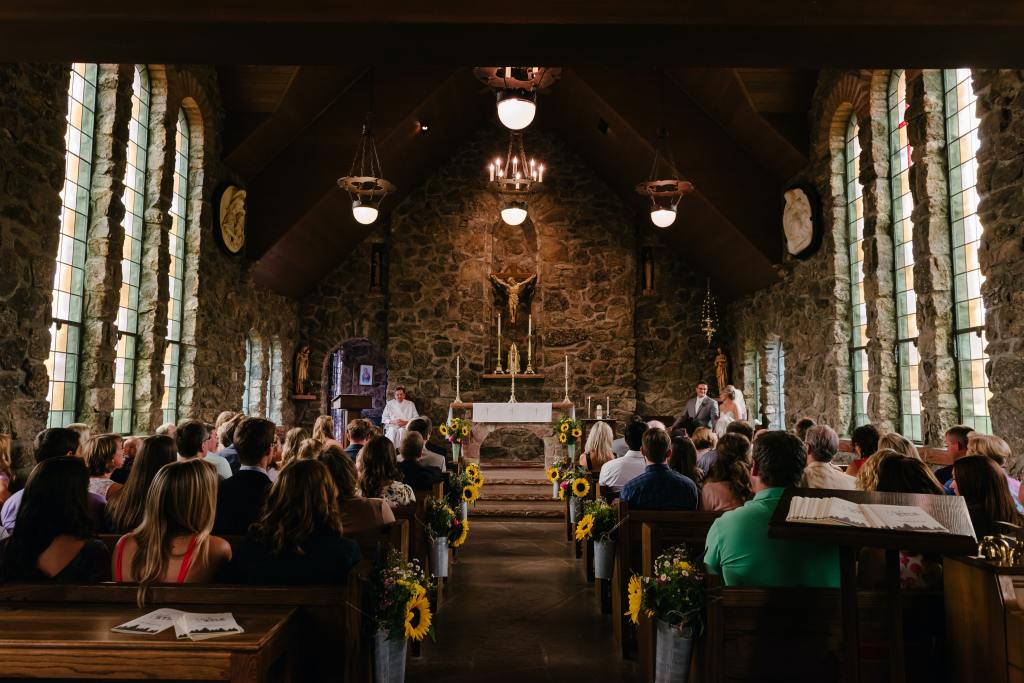
To begin, let’s be clear about WHY Mass involves so many actions on our part—it points to 2 main realities: one about us and one about the Mass.
First, about us: we pray with actions, not just with thoughts or words, because we are created by God as embodied souls. We are a union of spirit and matter—and when God calls us to worship Him we are called to worship as whole beings. We worship God who, for the sake of our salvation, took on our human flesh and did all the things we do—speaking, moving, blessing, reaching out, praying with His body. It’s His Body and Blood, Soul and Divinity that we receive in the Eucharist at Mass—so it makes sense that God would want us to prayer as embodied beings, rejoicing in and putting our bodies to work for the glory of God. At Mass, we worship with the angels, but we don’t worship as if we were angels—we worship as beings with bodies.
Second reason why we are involved in so many actions at Mass is because of what the Mass is—it is the greatest act of worship that re-presents the greatest act of sacrifice ever offered, ever! St. John Henry Cardinal Newman declared that Mass is “the greatest action that can be on earth.” We do not attend Mass to watch Mass. We attend Mass to participate in it—to join our hearts, minds, bodies and wills to the great act of worship and sacrifice that renews and strengthens the covenant bond between God and His people. We are called, as the People of God, to bring our conscious, active and full participation to the Mass. We are not there watching as the priest “does” the Mass—he is leading us in this great prayer. The priest, of course, has a unique role as the one who consecrates the Eucharist—acting in the very person of Christ through his ordination. But all of us, all the baptized, are priests of God as well—and the sacrifice on the altar demands us to offer the sacrifice of our life, our will, our love to God. So, through the priesthood of all the Baptized, we must offer worship and sacrifice at the Mass, too. Hence, all the actions.
Now you know why the Mass includes so many actions that we perform. Now, let’s go through them as we experience them when attending Mass.
The first action occurs when we enter the church. We dip our fingers in the holy water font and make the sign of the cross over our bodies. We do this in recognition or remembrance of our Baptism—it is by virtue of our Baptism that we are brought into the Body of Christ and gain the dignity of being a child of God. Because of our Baptism, we are welcome in the house of God—it’s our house, too! Because of our Baptism, we have the right and responsibility to worship God. Because of our Baptism, we have the authority to bring others before the Lord in supplication and mediation on their behalf.
So all the baptized are encouraged to use holy water upon entering the Church. What if you are not yet baptized? You can use the holy water and bless yourself as a sign of your eagerness and willingness to prepare for Baptism.
After we bless ourselves with Holy Water, we enter the Church and find a pew to sit in during the Mass. Before we enter our pew, Catholics genuflect. This means we lower ourselves onto our right knee while bowing our head—many make the sign of the cross while doing so as well. A genuflection was a medieval action offered to the king when one entered his presence. We offer the same action to our one, true king—Jesus Christ. Where is Jesus? In the Tabernacle. The fancy gold cupboard usually placed near the altar contains the Blessed Sacrament—the Eucharist. Jesus is truly, really and substantially present in the Eucharist—and His Real Presence doesn’t go away when Mass ends. So when the Eucharist is reserved in the Tabernacle, a red candle is lit nearby and we know that Jesus is abiding with us in the Sacramental Presence. We genuflect to our king to show that we acknowledge Him and acknowledge that this Church is His holy Temple.
Let’s go over the postures we use during Mass: we kneel, stand and sit. After we genuflect and enter our pew, we usually kneel for a while to pray—preparing ourselves to worship God with attentiveness, reverence and receptivity. Kneeling is a posture of adoration and supplication. We lower ourselves in order to honor God who is far greater. We kneel at the most important parts of the Mass—for example, we kneel during the Eucharistic Prayer when the words of Jesus at the Last Supper are spoken and the bread and wine become the Body and Blood of Our Lord.
We also stand together: we stand as Mass begins and then in other parts of the Mass (when we hear the Gospel reading or when we pray the Our Father, for example). Standing is a sign of our readiness to pay attention and receive “marching orders” as it were. We stand together to show what we stand for—our precious faith and the God who gives us our faith. We stand to show respect to people we wish to honor—especially Jesus who is proclaimed in the Gospel.
We also sit during the Mass. Sitting is the posture of the disciple—one who sits at the feet of Jesus, drinking in every word.
So throughout the Mass we change our posture to show what is going in the Mass and how we are called to respond—are we called to adore? Then we kneel. Are we called to profess our faith? Then we stand. Are we called to listen and receive? Then we sit.
Since when we come to Mass to become one Body in Christ—we should join in these postures together with the rest of the congregation, unless we are physically unable to do so. If a non-Catholic wishes to participate with us in all these postures and is free to do so according to their own conscience, then they are welcome to join us.
In addition to the changes in posture, there are other actions that belong to different parts of the Mass. Let’s go over them so that you understand their purpose:
During the first part of the Mass, we join together to confess our sinfulness and seek God’s mercy. We pray a prayer called the “Confiteor” that begins, “I confess to almighty God, and to you, my brothers and sisters, that I have greatly sinned, in my thoughts and in my words, in what I have done, and in what I have failed to do, through my fault, through my fault, through my most grievous fault…” While we say that last line, we tap our chest three times. What does this gesture mean? It’s a sign that we take responsibility for making the choice to sin. That we “own up”: rather than pointing fingers, we’re tapping over our hearts and admitting that we need mercy. It’s the humble, penitent action of a person who knows that, without the mercy and compassion of God, I’d be lost.
The next action we make at Mass is right before we hear the Gospel proclaimed to us. We stand to hear the Gospel, because we are hearing the very words of Jesus Christ. When the priest or deacon proclaims, “A reading form the holy Gospel according to Saint Mark (or Matthew, Luke or John),” he traces a big sign of the cross over the book. Then we say “Glory to you, O Lord” and mark three little crosses over our foreheads, our lips and our hearts. Please make sure that you sign yourself with the cross in a reverent, prayerful gesture—no sloppy fly-swatting!
Why are we marking these spots on our bodies with the sign of the cross? We want to consecrate ourselves to the Lord—our thoughts, our words and our hearts. To be a disciple of Jesus means to kill, to “crucify” the fallen, sinful modes of thinking, speaking and choosing that tempt us. We use the sign of the cross to remind ourselves that we die to self in order to live a new life—we crucify sin and are alive in Christ Jesus. We live, now, with the life of Christ in us. So those little crosses are a sign of our readiness to think about the words we are going to hear, to speak them with our lips and to cherish them in our hearts.
After the Gospel and the Homily, we stand to make our profession of faith. We recite the Nicene Creed together as our great and ancient confession of the truths that came to us from God Himself—the Creed is what we “stand for” literally as Catholic Christians. When we confess our faith in Jesus Christ, the Son of God, we say … “and by the Holy Spirit was incarnate of the Virgin Mary, and became man.” When we say these words, we make a profound bow, from the waist. Why? These words declare our faith in what’s called the Incarnation—that the Son of God took on human flesh and became one of us without losing His divinity. He did this to unite together, God and humanity, sundered by sin and to offer the perfect sacrifice that would heal the division caused by sin for all time. We make a profound bow because the fact of the incarnation marks the beginning of our redemption—consummated at Jesus’ crucifixion and affirmed in Jesus’ Resurrection from the dead. We bow at these words to indicate our profound, utter amazement at the mysterious love of a God who would sacrifice a Son in order to save a slave!
As we continue through the Mass, we kneel for quite a while during the Eucharistic Prayer—the great prayer of Thanksgiving where we re-present the sacrifice Jesus offered the Father, anticipated the Last Supper and realized at the crucifixion. We kneel in adoration as Jesus comes to us as true food and true drink—under the appearances of bread and wine that have been utterly changed into the Body and Blood of Jesus.
The one action at Mass that non-Catholics may not participate in is the reception of Holy Communion. But please know that it is our fervent hope that one day, all may be restored to full communion and share at the one Table! The reception of Holy Communion is not something all Catholics are automatically entitled to either. Catholics may only present themselves for Holy Communion if they are in a state of grace (having confessed any serious sins), have kept the communion fast (of one hour), and have participated with attentiveness and devotion in the Mass (good intention).
When we join the communion procession to receive Holy Communion, we are walking forward to renew and strengthen the covenant God has made with us beginning at our Baptism—we receive the sign of His covenant love for us, and we offer Him a sign of our willingness to abide in this covenant. It is a serious matter, an oath of life-or-death consequences—not to be taken lightly, thoughtlessly, or falsely. Love, true love, is costly—look at the crucifix! Oh, don’t misunderstand me—it is absolutely worth the price—but love demands our all. In Holy Communion, we first ask God to empty ourselves of ourselves, and then we are filled with the presence of Jesus Christ—we become what we eat, what we consume changes us—we don’t change Him!
Non-Catholics, even those who profess their faith in the Real Presence of Christ, cannot present themselves for Holy Communion until they become fully united (in communion) with the Catholic Church—otherwise the sign of Holy Communion is at odds with the situation in which one lives—the oath doesn’t match the life.
When we go forward for Holy Communion, we make a profound bow before Jesus present in the Eucharist. We receive Jesus either in our hands or directly on our tongue. We reverently consume the Sacred Host and return to our pew and kneel in thanksgiving. For non-Catholics or Catholics unable to receive, you are welcome to join in the communion procession and receive a blessing from the minister. Simply cross your arms over your chest as a sign of asking for the blessing. You don’t have to come forward: you are also welcome to remain in prayer in your pew if you would prefer.
Okay, final action at Mass: At the end of Mass, Father turns to the congregation and gives us a blessing. He says, “May almighty God bless you, the Father, and the Son, and the Holy Spirit.” As he speaks this blessing, he makes the sign of the cross over us. We make the sign of the cross over ourselves as we cooperate in the blessing of Almighty God coming down upon us. This blessing is offered to ALL the faithful, whether they can receive Holy Communion or not.
What an amazing thought, really, that Almighty God is not only willing to, but eager to bless us as we return to the everyday moments of our lives—the client meeting, the laundry, the baby’s bath, the laughter, tears, challenges and joys of daily life are brought under the blessing, guidance and protection of Almighty God. We’ve worshiped and received the incarnate Son of God at Mass, now it is our responsibility to incarnate the Son of God in our daily lives.
I hope these reflections help you better understand and participate in the Mass—we’ve just scratched the surface, really—the Mass is a treasure that takes a lifetime to unpack!
 Flourish Catholic