It a very common stereotype (and accurate in some cases) that Catholics, unlike other Christians, don’t know much about the Bible and don’t use it. I want to provide you with a more truthful understanding of how Catholics make use of the Bible.
We Catholics believe that the Bible is the inspired Word of God—it is the speech of God written down in human language under the guidance of the Holy Spirit. The Bible tells us the truth about God and the truth about how He wants us to respond to Him. The Bible is a treasured source of God’s self-revelation—a true gift and unerring guide.
Catholics are encouraged with the strongest possible language to read and study their Bible. “Ignorance of Scripture is Ignorance of Christ” declared St. Jerome almost 1600 years ago. Our Catechism teaches: “The Church forcefully and specifically exhorts all the Christian faithful … to learn the surpassing knowledge of Jesus Christ by frequent reading of the divine Scriptures” (CCC #133).
We have made it clear WHY Catholics are urged to read the Bible. Now I want to address two more matters: HOW we read the Bible and WHEN we read the Bible.
First: HOW do we read the Bible? Catholics do not adopt a fundamentalist, literal reading of the Scriptures. We read the Bible literarily, not literally. In other words, we are encouraged to pay attention to the literary form of the passage, the author’s audience and intention, and the context of the Biblical passage. We read each passage of Scripture in light of the entire Bible and of what we know to be true about God—especially when we read confusing or challenging passages. We do not pull a verse out of context and use it to prove a point we already formed in our minds—we read the Bible with a humble heart and searching mind, reading in order to know the Author of the words rather than reading to serve a utilitarian purpose we bring to the Bible.
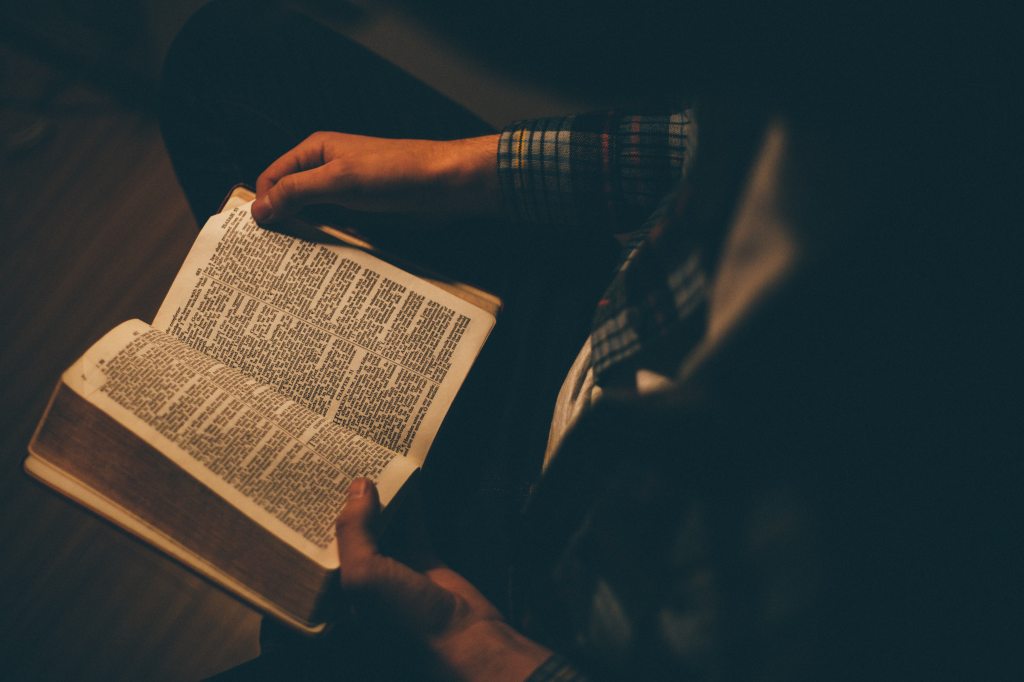
So HOW do we read the Bible? As a lover would read a love letter penned by her beloved. As a child would read a letter sent by a much-loved parent or grandparent. We read the Bible by asking the Holy Spirit—the true author of every book in the Bible—to inspire us and guide us. We read the Bible to learn the surpassing knowledge of God and what He wants of us. If, when we read about God’s commandments, we only think about other people—we’re missing the point of God’s intention for our souls!
The Bible is comprised of 73 books—46 in the Old Testament and 27 in the New Testament. It was written over a span of more than 1200 years and comes out of a culture and time very different from our own. For these reasons, it is imperative to have guidance and instruction when reading the Bible.
But the most important thing is to read it. The next most important thing is to find a good Catholic study Bible with commentary and notes that will help you learn how the Catholic Church has interpreted and applied Biblical passages to real life situations. I recommend using the New American Bible, Revised Edition or the Revised Standard Version, Second Catholic Edition. You can find many good Catholic study Bibles at a Catholic bookstore or online.
Last suggestion about HOW to read the Bible: begin with one of the Gospels that tell about the life of Jesus—Matthew, Mark, Luke and John. Next, read Acts of the Apostles that relates the history of the early Church after Jesus’ Resurrection and Ascension to heaven, and then some of the Letters in the New Testament from St. Paul or St. Peter.
What about the Old Testament? Don’t ignore it or think it is unimportant! It is part of the Bible—God’s inspired word and we cannot fully understand Jesus unless we understand God’s covenant unfolding throughout time before the Son of God came to earth. Explore the Old Testament in light of what you have read in the Gospels and the New Testament. I encourage you to use a children’s Bible to read the entire sweep of the Old Testament—the key events and people are included in the children’s version and it will help you make sense of it all.
A helpful way to dive into more of the Bible is to follow along with the readings from Daily Mass—this will break the Bible up into meaningful “chunks.” The readings from the Old Testament were selected to complement the Gospel readings—so it helps you make sense of the Old Testament. If you keep up with the readings from Daily Mass and Sunday Mass, you will make your way through almost all of the Bible every few years! You can find the daily readings on many websites, including the US Bishop’s website.
We have covered a bit about HOW to read the Bible. Now I want to share WHEN to read the Bible.
TODAY. Begin, restart, continue reading the Bible TODAY. It is easy to put off, easy to fill our hearts and minds with the content of this world and to avoid or forget about reading the Bible.
Commit to TODAY. Open the Bible in the morning, at your lunch break, in the evening—make time to you sit down and listen to the Lord.
When we feel alone, when we feel discouraged and beaten down, when we feel lost and confused—don’t we all wish that God would speak to us? Don’t we all wish that we could know God’s heart and intentions for us? Don’t’ we want to be assured of His love and tender care of us?
“Can there be a more fitting pursuit in youth or a more valuable possession in old age than a knowledge of Holy Scripture? In the midst of storms it will preserve you from the dangers of shipwreck and guide you to the shore of an enchanting paradise and the everlasting bliss of the angels.”
St. Boniface
God does speak to us. Every time we open the Bible and read, God’s words, coming from the very heart of our loving Father, are entering into our hearts and minds. God speaks. We listen. God speaks. We decide to respond. God speaks. We fall in love.
So, WHEN, specifically, can we read the Bible? Each day in our personal devotions. I really encourage the use of the Liturgy of the Hours—morning and evening prayer are filled with the recitation of Psalms and the reading of Scripture—it is a daily immersion in the Bible that is truly enriching. There is a great app for your phone called IBreviary—it is a free way to easily access the prayers used in the Church for each day.
There are tons of devotional booklets that help you unpack and apply the Mass readings for each day—find one you like and incorporate it into your daily prayer. I really like Magnificat and the Word Among Us.
Write down favorite verses that you encounter in the readings from Mass or the Liturgy of the Hours. Post them around the house—surround yourself, literally, with the word of God. Listen to music that puts Bible passages to song—or listen to the Bible performed as radio drama.
Spend time with Gospel passages doing a form of prayer called Lectio Divina (that’s Latin for the Sacred Word). In this meditative prayer style, you select a passage to pray with. Choose one that tells a vivid story and that isn’t too long—such as the story of Jesus healing the Paralyzed Man in Mark 2:1-12. You read the passage for the first time to understand the story as it is told. You read the passage slowly and then reflect on it as an observer—notice details, make sure you can retell the story and that you don’t gloss over details. Then, you approach the passage for a second time. You read it and immerse yourself in the story as a participant—you imagine what it would be like to witness the man being lowered through the roof, how Jesus looked at him, how the crowd reacts when the man is healed. After a time of reflection, you prayerfully read the story a third time one-on-one with the Lord. This time, you ask the Holy Spirit to help you uncover a message meant for you in the story—how you personally are touched, consoled or challenged by this living Word. You meditate, you talk to God, you quiet your heart and listen to the Holy Spirit. Then you conclude your time of Lectio Divina by resolving to take some action in response to the message—perhaps God is using the story to inspire you to bring a friend paralyzed by discouragement or fear to Jesus, for example. I suggest keeping a prayer journal of your Lectio Divina experiences—and your reflections on other Scripture passages.
Finally, maybe most importantly—go to Mass and really listen to the readings from Scripture that are proclaimed. Listen, not with a critic’s ear about who is proclaiming them and how they are doing! No! Listen in the same careful way you might listen to your doctor telling you about your test results. Listen in the same receptive way you might listen to a beloved friend or family member share some message meant only for you. Listen in the same attentive way you might listen to a first responder give you instructions that could possibly save your life. Listen with care—with a humble heart willing to submit to the Word of God and allow it to be living and active in you—even if that means some dreadfully uncomfortable pruning and cutting!
We Catholics believe that at Mass we are given the Real Presence of Jesus Christ in the Eucharist—in a powerful and Sacramental way Jesus enters into our soul and abides with us. Well, we also believe Jesus is really and truly present in the Word proclaimed—all the words of Sacred Scripture proclaim the one Word of God, Jesus Christ. Be just as attentive to the presence and power of Jesus in the Word as in the Eucharist. Receive Him with joy. Let the Word abide in you.
 Flourish Catholic