Honoring the Blessed Virgin Mary is a distinctive hallmark of the Catholic faith—and one of the parts of Catholicism that sometimes most concerns and troubles non-Catholics. Our doctrines and practices regarding Mary are so critical because of what they declare about Jesus Christ and His Body, the Church. Let’s explore what Catholics really believe about Mary, dispelling misunderstandings and myths, and connecting these doctrines and practices to our own spiritual growth.
First, let’s clarify right away that Catholics do not worship Mary as a goddess. We rightfully give her the title “Mother of God” because of the nature of her Son—the divine Second Person of the Most Holy Trinity who took on human flesh beginning in her womb. We do not use that title to declare Mary’s divinity, only her Son’s.
The honor we give to saints is different from the worship we give to God—even though the two Latin terms are both translated as “pray” in English. We dulia (honor) the saints when we pray to them—which is shorthand for asking a saint to pray with and for us, not to adore them as when we pray to God. The Latin word for praying to God is “latria”—and this worship and adoration is given to God alone. Mary, then, receives our “dulia” as a saint to be honored and venerated, and from whom we humbly seek intercession for our needs and the needs of others. In fact, because Mary is the greatest of all the saints and the Queen of heaven, we give her “hyper-dulia”—the greatest honor given to any human person. It is still qualitatively different from the worship we give to God—idolatry is a line that we cannot and will not cross.
Why is Mary honored so much? Why is she the subject of countless works of art, countless songs, innumerable prayers and multiple pilgrimages? Because Mary is the model of the Christian disciple, the archetype of the Church and the first of all human persons to be given the graces we will all receive at the end of time. God created Mary as the New Eve, the one who would vanquish the serpent by giving birth to the New Adam, the One who would accomplish all things the first Adam refused to do in Eden. Her obedience was the one thing God required to continue with His plan of salvation—the one thing she had to freely give or the Savior could not be born. Her “fiat”—let it be done to me according to Your word—was the “yes” that undid the “no” of Eve.
“The knot of Eve’s disobedience was untied by Mary’s obedience; what the virgin Eve bound through her unbelief, the Virgin Mary loosened by her faith.”
St. Irenaeus
But it wasn’t just a one-time event, this “fiat”—her entire life was a continuing echo, a deepening and strengthening, of that first “fiat.” She continued to give her yes, even as she watched her Son suffer and die for our sins. This greatest of all human beings shows forth the marvelous way God has of turning us fallen human beings “right side up.” In our twisted, upside down way of thinking, the most important and powerful people are the ones with money, influence, fame and admiration. Who really thinks, even now, that a poor Jewish woman was and is the critical human link in Satan’s downfall—that she would be the one person raised to the highest heights of heaven? “The first shall be last, the last shall be first”—I can imagine Jesus giving His mother a smile and wink as He spoke those words in Galilee!
Let’s briefly review the Catholic doctrines regarding Mary—those beliefs we hold as coming from Divine Revelation and therefore true. We profess that Mary is the Mother of God, that she was created free from Original Sin (the Immaculate Conception), that she remained a Virgin, that she was assumed into heaven and was crowned Queen of heaven. We speak of Mary as the first disciple, the Mother of the Church, and Our Blessed Mother, too.
Remember the basic rule of all the Catholic Church’s doctrines about Mary—they are intended to point to and defend our doctrine about Jesus. The way forward with regard to Marian doctrines, therefore, is to relate them to the bedrock—our doctrines about Jesus.
So to use the title “Mother of God” for Mary is to assert something very important about her Son—He is truly God incarnate, the Second Person of the Most Holy Trinity, the Father’s Only-Begotten Son, took on our humanity without losing His divinity. Jesus, born of Mary, was not a divided person, ½ human born of Mary and ½ God born of God. The two natures of Jesus—human and divine—exist in perfect, inseparable unity in the one Person, Jesus Christ. To assert that Mary is the mother of Jesus but not the mother of God is to deny the eternal divinity and the unity of the one Person Jesus who has two natures. Jesus is ONE person with two natures. Mary gave birth to the one person Jesus Christ, but this doctrine does not claim that she is the source of His divinity. This doctrine also does not imply that Mary is the mother of the Most Holy Trinity—God the Father, Son and Holy Spirit is eternal and has no beginning, therefore no mother.
The doctrine of Mary’s Immaculate Conception states that God, by a singular grace, preserved Mary from the stain of original sin and from committing personal sin throughout her life. The miracle of Mary’s Immaculate Conception demonstrates how God prepared her for the greater miracle of the Incarnation. Jesus Christ, truly God and truly human, is the incarnation—the enfleshment—of the God who dwelt in majesty in the Temple. Jesus is like us in all things but sin. He is all holy and perfectly united to the Father. The incarnation required a human mother. Since Jesus is God and God cannot be tainted with sin in any way, Jesus’ mother would need to be created in such as way so that the power of sin and Satan would not be in her. Therefore, God created the mother of Jesus to be immaculate, or free, from sin.
Just as God’s presence in the Temple required a pure vessel perfect and beautiful, so, too, does Jesus Christ—He requires a Tabernacle untouched by sin. Mary was prepared by God to be the new Eve—the woman, the archetype of all womanhood—who would receive the Word of God into her very being and cooperate with God’s loving plan of salvation. God created the first Eve in perfect harmony with His nature—and so God created the new, second Eve in the same way. Mary’s Immaculate Conception, therefore, points to the nature of her Son.
Some people are concerned that this doctrine denies the truth that all men have sinned and fallen short of the glory of God and need a Savior. Well, even that verse requires some interpretation, doesn’t it? We don’t think Paul meant that babies sin, for example, so he doesn’t literally mean “all men” without exception. And babies who die still need a savior: no human being can open heaven’s gates on their own. Mary required salvation by her Son just as we all do—but God anticipated Jesus’ redemptive sacrifice in giving Mary the grace of being unstained by original sin. She admits as much in her prayer we call the Magnificat—where she declares that her soul rejoices in God her savior. Mary, too, was saved by her Son—and prepared even before her birth to be able to play a role in salvation history that no other human being ever played—to literally give birth to God.
“Mary conceived Jesus in her heart before she conceived Him in her womb.”
St. Augustine
It is fitting that God would enable the woman who would be the Mother of the Son of God to avoid the stain and taint of sin; otherwise, how would she be able to say “yes” with complete freedom? How could she cooperate with her Son’s mission and work and sacrifice if the selfishness and weakness of sin inhabited her soul? How could she love her Son and yet be able to completely give Him to the world if sin compromised her? Being created free from sin and given the grace to resist sin throughout her life shows the possibility, the power, the outrageous excellence that God dreams for all us in heaven. Because of Mary’s role in salvation history, she enjoyed that heavenly life here on earth.
One young woman in my 7th grade religious class protested the special treatment of Mary by God. “God doesn’t play favorites,” she told me after class one day, “so He wouldn’t do something for Mary that He didn’t do for anyone else.” “Your idea about God not playing favorites is correct,” I said, “but equal love does not mean equal treatment.” She looked at me puzzled. I went on: “A good father understands how his children need to be loved, and that is very different from child to child. The last thing we would really want from our Father God is equality—if we really think about it, we want Him to know us and love us as individuals with specific needs. God knows what is best for us and always brings it about—but in very different ways with different souls. Mary played an utterly unique role in God’s plan of salvation—so she needed utterly unique gifts from God. God does not love Mary more than you or me—but God’s love is differently expressed because of our different abilities and role in His plan.”
In addition to Mary’s Immaculate Conception, we believe that Mary remained a virgin throughout her life—one of her main titles is the “Blessed Virgin Mary.” Some people mistakenly believe that this doctrine demonstrates the Catholic church’s rejection of marriage and sexual intimacy. No, that’s not the message of this doctrine. Mary’s virginity is in no way meant to be (or ever used by the Church as) a devaluation of sexual intimacy within marriage. Instead, remember the basic rule: Marian doctrines point to doctrines about Jesus.
We confess that Jesus is the bridegroom—and his bride is the new Israel, the Church. He sacrifices himself for his bride and unites himself to her by his Passion and Death. By his resurrection, he wins a home for his bride in his Father’s kingdom. When he returns, the marriage between God and humanity will be consummated as we are brought into the everlasting joy and glory of heaven.
So, if Jesus is the bridegroom and represents the new Adam, what about His mother? She represents the new Eve: Eve’s name literally means “mother of all the living.” Mary is the woman who will be the “mother of all the living” in heaven. As spiritual mother to all who believe in her Son, she has no need for natural-born children. Her Son, Jesus Christ, is her only child, her “firstborn” of many spiritual brothers and sisters. It would make sense that Mary, representing the Tabernacle of the Lord within which the Presence of God resides, would have no other children—the Tabernacle has but ONE presence.
So what about those passages in the Gospels that speak about the brothers and sisters of the Lord—doesn’t that refute the Catholic doctrine of Mary’s perpetual virginity? Catholic commentators point out that the Hebrew language has one term referring to all one’s relations—brothers, sisters, cousins and in-laws. All are “brothers and sisters” from the viewpoint of the Jews of Jesus’ time. This interpretation is consistent with another important clue in the Gospel accounts. At Jesus’ crucifixion, Jesus made a point of giving Mary into the care of his beloved disciple, John. If Mary had other children, this would have been unnecessary: they would have taken Mary into their care and provided for her. Because Jesus was her only child, he had to ensure that there was someone who would care for her after His death, resurrection and ascension into heaven.
Jesus ascended into heaven 40 days after his resurrection from the dead. The apostles, united around Mary, waited in Jerusalem for the outpouring of the Holy Spirit at Pentecost. After some time, Mary went to Ephesus with the Apostle John. But then what? Our doctrine of the Assumption declares our belief that after Mary’s life on earth ended, she was taken body and soul into heaven. The doctrine does not say whether she died or not before she was assumed into heaven: the eastern Church speaks of the end of Mary’s life as a “falling asleep”—a “dormition”—before her assumption.
The terms ascension and assumption are key: Jesus ascended into heaven. As the divine Son of the Father, Jesus had the power within Himself to ascend to heaven. Mary was assumed into heaven—she had no power to go there by herself, but required being taken to heaven by God. Two other people in the Bible were described as being assumed into heaven: Enoch in the book of Genesis and Elijah in the second book of Kings. So the precedent had already been set, by why would Mary be assumed into heaven?
The natural process of death, of body and soul separating until Christ’s Second Coming, is actually not “natural” at all—it is an outcome of sin’s entrance into the world and was not part of God’s original design. God created us to be an eternal union of body and soul. The book of Wisdom declares that God did not create death and wills no one to die. Death is the result of the devil’s envy and of our sins. So, if Mary is sinless, death would not impact her in the same way it does the rest of sinful humanity—death would simply end her time on earth, it would not be a sundering of body and soul. Death would be the process of leaving God’s created world and entering the eternal kingdom of God: assumed body and soul into heaven.
We have historical evidence for Mary’s assumption. There is not now and never has been a church, shrine or pilgrimage site built over the bones of Mary. With all the tombs of our saints and martyrs filling up Rome, Jerusalem and other ancient Christian cities, isn’t it downright impossible to imagine that if Mary had died and was buried, that her tomb wouldn’t have been preserved? That would be the one tomb we would all want to visit to honor the Mother of Our Lord. But there is no such place on earth. Why? Because her body wasn’t buried and didn’t decay in a tomb on earth—her body and soul remain united in heaven.
Mary’s assumption into heaven points to what will happen to all of us at the end of time. We profess our belief in the resurrection of the body—when we will be body and soul again, forming one Person, in the glory of heaven forever. St. Paul reflects on the nature of the resurrected body in heaven—its spiritual capacities and glorious attributes in the 15th chapter of 1st Corinthians. Mary’s experience is not at all something outrageous, since God has promised that we will all have bodies in heaven after the Second Coming. What is beautiful and astonishing is that God provided Mary to us as a model (Mom goes first!)—to fill us with hope and comfort and anticipation even as we confront the loss and sorrow of the death of our loved ones.
“My dear little son, I love you. … I am the ever-virgin Mary, Mother of the true God who gives life and maintains its existence. … I am your merciful Mother, and of all mankind…. Am I not here with you who am your Mother? Are you not under my shadow and protection?
Our Lady of Guadalupe speaking to Juan Diego
After Mary’s assumption into heaven, we confess that she is made Queen of Heaven. Some Protestants grow concerned about this doctrine—thinking it says something weird and perverted about the relationship between Mary and her Son, the King of heaven. Rest assured, no strange incestuous relationship is suggested! We Catholics understand Mary’s Queenship as the perfect fulfilment of the Biblical vision of Queenship. In the age of the Kings and Queens of the Jews, beginning with King Solomon, the Queen of the reigning King was never a wife (of which some kings had many!). The Queen was the King’s mother—granted a throne and authority second only to the king. The Queen’s special role was to be an advocate, an intercessor for the needy, the forgotten, the marginalized among the citizens. And that’s how Mary’s Queenship works in heaven as well—she speaks up for the “little ones” among her spiritual children.
The Queen’s role is to amplify and clarify the commands of the King—to speak on his behalf not to take away his power, but to reflect it. The Queen gives glory to the King by being his special ambassador and by being the most loyal of all the King’s subjects. Because of her special role in the Kingdom, when the Queen speaks, the King listens. It is his joy to grant the queen’s wishes. It does the King great honor and joy when his subjects honor and obey his Queen.
Now that we have briefly covered the Marian doctrines, I want to reflect on some of the various titles and images of Mary. We call her Mother of the Church because of her role as our spiritual mother—as the bride of the Holy Spirit, she gave birth to one biological Son, our Lord and Savior. At His command while dying on the cross, she accepted multitudes of spiritual sons and daughters. I think this is one of the features of Mary that makes me love her most. She participated physically and spiritually in the sacrifice of Christ on the cross—we know, biologically speaking, that a child grows from cells he receives from his parents. Jesus had only one biological parent—all the physical matter that made up his body originated from the Blessed Mother. She was a part of him in a way no other human person ever will be—in a way, we can say that Mary communicated herself to her Son before He communicated Himself to her in the Eucharist.
As she stood by her son who was dying in tortured agony, wouldn’t it be the most reasonable, the most “natural” thing in the world for her to be filled with disgust and hatred at those who caused her Son’s death? How could a mother, knowing that her Son was perfectly innocent and filled only with love, forgive those who caused her Son so much suffering? Yet, she does. She doesn’t simply forgive us, she enfolds us as her children. She is filled with love for each one of us—knowing that our sins caused her Son to go to the cross. Knowing that if we were the only sinner saved by her Son’s death, that He would have died for us—and that our sins required her Son’s death for their redemption. What amazing, perfect love Our Blessed Mother offers us—a reflection of the perfect love of God! And that’s a favorite image of Mary for the Church. We see her as being like the moon. The moon shines bright in our night sky, but it gives off no light of its own. The only light it has is the light reflected from the sun. This is Mary—the light she gives off is solely the light of her Son. It is SON-shine that makes the mother so bright!
We call Mary the Blessed Virgin Mary or Our Blessed Mother—titles of respect and honor that reflect our doctrines. They also reflect the source of Mary’s sanctity: the blessedness of God. It is God’s grace that created the perfect woman, Mary. And by God’s grace, Mary intercedes on our behalf to her Son—and finds such joy in doing so.
Mary’s intercession reflects the generous and inclusive heart of God. He doesn’t need intercessors—there isn’t a chance that God didn’t notice someone or didn’t value someone or is too busy to pay attention to someone. That’s not why God allows (and seems to desire) intercession. Intercessors have the joy of cooperating in the designs and plans of God—and of unleashing God’s power and grace into the world. God doesn’t need the help—but He sure seems to delight in it! Mary’s intercession does nothing to increase God’s power—but Mary’s intercession is used by God to focus and direct His power. Like the power of light to scatter into beams of different colors when shone through a crystal—Mary’s pure and beautiful heart refracts the light of God’s love into thousands of different beams, working their way into the hearts and lives of her spiritual children, all for the glory of God.
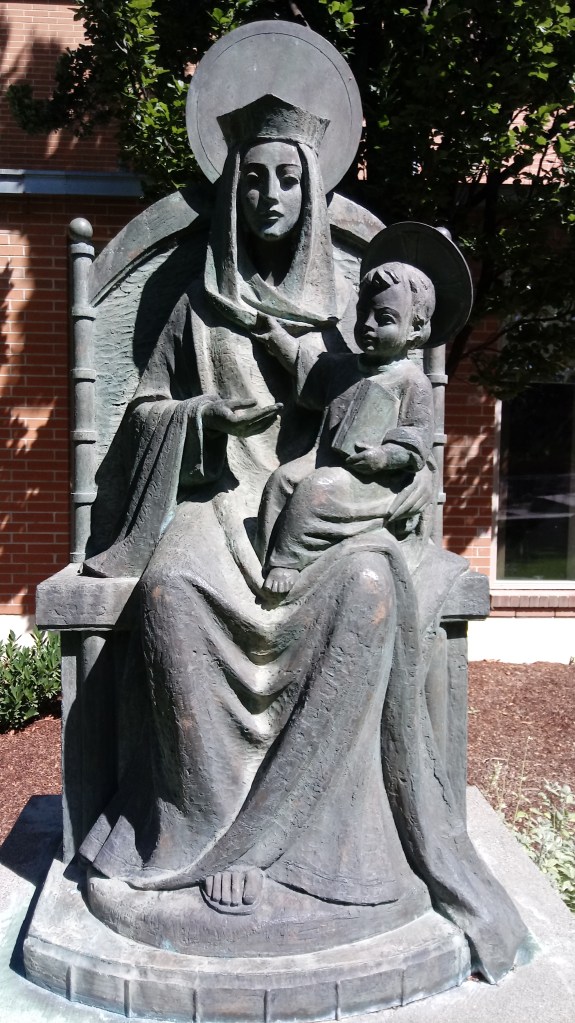
Have you noticed that in most Marian icons, Mary is posed with her eyes gazing at the viewer and one of her hands pointing to her Son? Those icons testify to the spiritual role of Mary—she holds our gaze, imploring us to pay attention to her instruction. Then she speaks of her Son—asking us to listen to Him, to look at Him, to love Him and to serve Him. Her last recorded words in the Gospel speak to her role in God’s kingdom. She instructs us to “do whatever my Son tells you” (John 2:5).
And what about the Rosary? Is it truly an effective prayer or is it an idolatrous action? Many people who concede that Mary played an important role in salvation history still resist the Rosary, seeing it as praying to Mary and worshipping her instead of God.
We Catholics are never taught that the Rosary is a prayer TO Mary in that sense—we do not worship Our Blessed Mother even when we ask for her intercession. Instead, the Rosary is an extended meditation on the Gospel events in the life of Jesus Christ, as seen through the eyes of His Mother. As we meditate on the mysteries, we are drawn into contemplation of Jesus Christ. As we recite the prayers that come from the Bible, we speak words spoken by Jesus, words spoken by the Archangel Gabriel, and words that echo the songs of heavenly worship as recorded in the Book of Revelation. The Rosary allows us to slow down the “hamster wheel” in our brain and, through the simplicity and rhythm of the repeated prayers, enter into calmness and peace. It is there that we meet, adore and visit with God.
“By its nature the recitation of the Rosary calls for a quiet rhythm and a lingering pace, helping the individual to meditate on the mysteries of the Lord’s life as seen through the eyes of her who was closest to the Lord. In this way the unfathomable riches of these mysteries are disclosed.”
Pope Paul VI
Mary, our Blessed Mother, isn’t the one being prayed TO, she is the one being prayed WITH. This is shown in the many apparitions of Mary that have happened throughout the ages and in many different places. After a child or adult sees the vision of Mary, it is common for them to pull out a rosary and begin praying it. What does Mary do at that point? She has a rosary and begins praying with the visionary. If the rosary were a prayer to Mary, then she would receive the prayers, not pray along. What god or goddess prays to themselves? If Mary takes up the beads and prays, then she is praying to God, to someone beyond herself. That’s what we’re doing as well.
A final image of Mary refers to her cloak, or mantle. We speak of being “under Mary’s mantle” in reference to her patronage, her protection and guidance, of those seeking her aid. I love that image—as a parent, I know the delight a little child feels when Mommy wraps them up in a blanket and cuddles them. Mary’s mantle can cover us in times of spiritual or physical danger—she becomes not just a powerful symbol of, but a real instrument of God’s care for us. When a child is in danger, they run to Mom—and not because they think God isn’t protecting them, but because they know God’s protection comes through loud and clear when Mom is the chosen instrument! The same is true with our spiritual Mother—her mantle is the means, the instrument, used by God to cloak us in His love, protection, guidance and security. Especially when we face temptations to sin, especially sins against purity, we can call upon Our Blessed Mother to cover us with her mantle and shield us from the temptation we are struggling against. Moms rescue us, protect us, admonish us and empower us to achieve excellence—maybe that’s why it seems a huge majority of Olympic athletes seem to want to say “hi” to their mom when interviewed after their victories!
Moms also show up. When a child is in need, Mom’s move with “momma bear” speed! Our Blessed Mother is no exception! Mary’s apparitions to people (mostly children) are widely documented, as are myriads of miracles worked through her intercession. Mary is eager to take on her role as our Blessed Mother, guiding us, admonishing us, protecting us and encouraging us—always, no matter what, her message is to love and obey her Son. Every mother yearns for her child to be loved and treasured by others as much as she loves and treasures them. What better thing could our Blessed Mother want from us?
 Flourish Catholic