Many years ago, I glanced down at my left hand on Corpus Christi Sunday and something caught my eye. The diamond was missing out my engagement ring! I was busily preparing the church for our First Holy Communion Mass beginning in under an hour, but I stopped and began searching for the diamond. Maybe it fell off as I was placing the reserved signs on the pews? My eyes searched the floor. Perhaps it dropped out while I was assembling all the certificates for Father to sign? I went into the Sacristy. Not finding it, I retraced my steps to my office, to the parish hall and back into the church.
A flood of memories came pouring into my mind. Sitting with Matt in the Space Needle restaurant, watching the city lights below. The musician starting to play “Time in a Bottle” as Matt nervously came back to our table. Me, bemused, wondering what he was up to. Matt offering me the engagement ring as he asked me to be his wife. My yes.
And the diamond was gone! I realized that, of course, it might have been missing for hours and could have fallen off anywhere—at home, on the sidewalk as I walked to church—and there was really no chance of finding it. A tear slid down my cheek and I keenly felt the loss. Our deacon noticed and came over to check on me. I told him what I had discovered, and he started looking for the diamond all over the church. But it was gone.
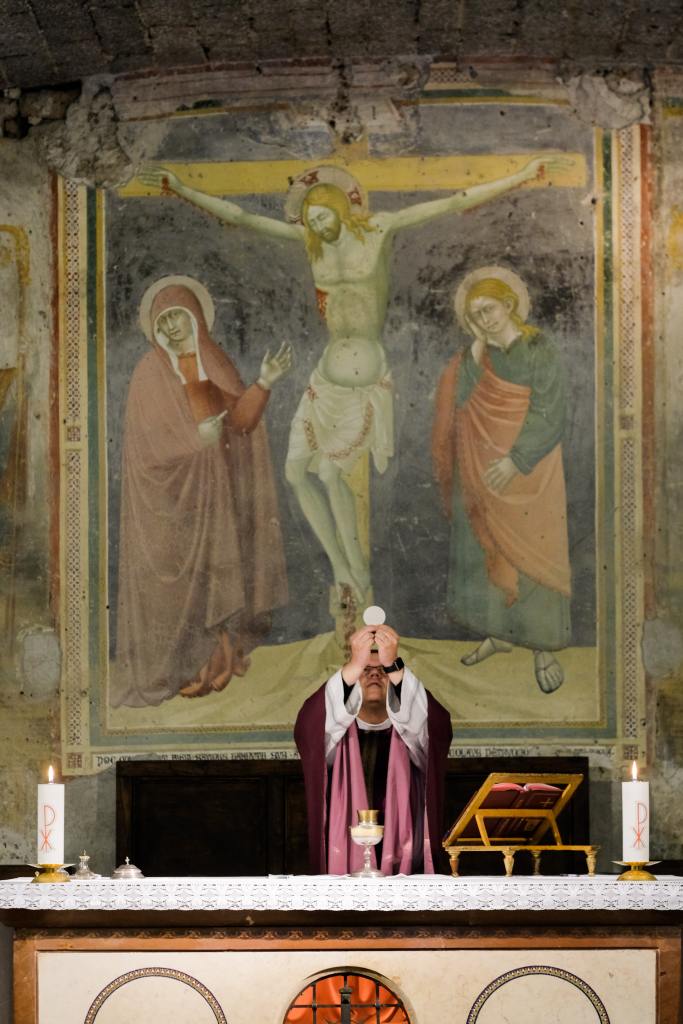
As I struggled through the Mass, I turned in prayer to the Lord. “Lord, what’s the lesson for me in all this? How are you speaking through this experience?” Then it hit me. Here I was at the Mass on the Solemnity of the Most Holy Body and Blood of Jesus, Corpus Christi! I was kneeling in adoration as the bread and wine were changed forever in the Real Presence of Jesus Christ for us to receive. We Catholics see the gifts of bread and wine as signs of God’s love—signs that actually bring about what they signify. They are not symbols of Jesus’ actions two thousand years ago. Through the priest, acting in the person of Jesus Christ and saying the words Jesus spoke over the bread and wine, they cease being bread and wine and become the Body and Blood of Jesus Christ. Their appearance doesn’t change, but the reality of what they are, their nature, has changed completely.
My diamond engagement ring is a symbol of our love. However much it meant to me, it did not contain, offer, preserve or effect love. It symbolized Matt’s desire to unite with me for the rest of our lives—but it did not provide the grace, the means or the method for doing so. That diamond was beautiful as a symbol, but it was worthless as a sign.
I experienced the Holy Spirit’s comforting presence in my soul during that Mass. I knew that God was not punishing me for missing my diamond and He was not making light of what I had lost. But He was also gently and clearly inviting me to “put first things first” in my mind and heart.
Would I be as distraught about not receiving the sign of Jesus’ sacrifice for my sake as I was about losing the symbol of Matt’s love for me? Do I seek and search for ways to honor and adore Jesus in the Eucharist with as much zeal as I searched for my missing diamond? Was I treating the Eucharist as a lovely symbol of my faith or my devotion and refusing to cooperate with the deep and transforming work that God desired through this sign of His Presence?
As I went forward to receive Our Lord in Holy Communion, I was aware of the greatness of the gift being offered me. Unlike my diamond, Jesus’ Presence in the Eucharist was a treasure beyond measure. Matt scrimped and saved to purchase that engagement ring, and it had a monetary value, a “worth” that could be quantified. The Eucharist I would soon receive would offer me the Creator of all things, the Creator of my diamond and every other thing of “value” in the world as well. The Eucharist is the “pearl of great price” that cost Christ everything to purchase—He poured out His very life for us. When I receive Holy Eucharist, I am taking into my body, into my life, the source of all life, the Creator of my body and everything else I see and can’t see. What could we humans possibly offer as payment for such a gift?
And that’s the point, isn’t it?! It is gift, grace—not to be earned, but gratefully received. Never something we are entitled to grasp, but something we are invited to accept. Since there is no way for us to purchase the sign of our salvation, God the Father offers it freely out of love. Since there is no way for us to deserve or earn our salvation, God the Son steps in and makes the offering Himself. Since there is no way we can fully and completely comprehend the enormity of the gift, God the Spirit within us receives the full “assault” of this tidal wave of love and allows us to experience the tiny trickles and splashes that refresh us without undoing us.
We need more than we can pay for. We need more than we can take in. So, God offers us the sign of His love—the Bread of Life that sustains and nourishes and transforms us. We depend upon God not only for the invitation to love Him, but the resources and ability to love Him. That is why we need more than a symbol of His love—we need an effective sign. Jesus, loving us completely and loving us until the end, would not offer Himself for our sakes on the cross until He had provided the sacrificial meal that would make His offering available to us in every time and every place. He eagerly anticipated His crucifixion, death and resurrection at the Last Supper. When He offered Himself to us under the form of the bread and wine at the Passover meal, He explained the meaning of His sacrifice: “This is my body, offered for you.” “This is my blood of the covenant, poured out … for the forgiveness of sins” (Matthew 26:26-28).
St. Paul teaches us that sharing in the Eucharist is a true encounter with the Lord—for if anyone “eats the bread or drinks the cup of the Lord in an unworthy manner will be guilty of profaning the body and blood of the Lord” (1 Corinthians 11:27). Jesus is really and truly present in the Eucharist—body and blood, soul and divinity. Jesus is completely and gloriously living for us and in us and through us. As our bridegroom, He is eager to give Himself to us, to unite Himself to us with an intimacy that is far deeper, truer and more life-giving than the sexual union between husband and wife. We are drawn in and through this sign, into an intimate encounter with God as we renew and strengthen the covenant He established with us at our Baptism.
The Eucharist is THE sign of Christian discipleship: it is, until we see God face-to-face in heaven, the closest we can be to our Lord and Savior. The Eucharist is THE sign of God’s intention for each believer and for the Church—He desires intimate union with each soul, and He desires to draw us into an intimate community that shares One Life as the Body of Christ. Second Vatican Council called the Eucharist the source and summit of the Christian life (Lumen gentium, 11). Jesus Christ, present to us in the Sacramental signs of the meal, is the origin and the destiny of everything good we can accomplish and everything good we can receive.
This is why, throughout the centuries, Christians were willing to die for the Eucharist—because the Eucharist IS Jesus Christ. This is why we go to extravagant lengths to honor the Eucharist in the Mass and in Eucharistic Adoration—because in honoring the Eucharist we are honoring Jesus Christ present in the sign of the Sacrament. We see the Eucharist as the “appetizer course” of the banquet in heaven—a banquet that is described as the wedding feast of the Bridegroom and His Bride.
After receiving Holy Communion at a Mass many years ago, I went back to my pew and knelt down in adoration of the gift I had received—I had received not just a gift, but the Giver of all good gifts! I prayed in silent adoration and spoke to my Lord, now present in a uniquely powerful way in the Temple of my body: “Oh Jesus, my Lord, I would die, I would give my life, for love of you in the Eucharist!” “Yes, my dear one, you pledge your readiness to die for me,” the Lord whispered back into my soul, “but would you choose to live for me?”
Jesus joyfully receives the rash hyperbole of promises spoken by a heart madly in love with Him—but He is not wanting us to stay in that “honeymoon suite,” so to speak. In my marriage, I prove my love, I incarnate my love for my husband in the choices and tasks of daily life—not just in the passionate and intense moments. Love transforms the dreariness and drudgery of life—but not by making things less dreary and “drudge-y”—but by giving us a motive, a reason, for offering the best of ourselves even in these times. The same is true in our walk with the Lord. Our love for the Lord, received in a powerful and intimate way in Holy Communion, doesn’t disappear until we present ourselves for another intimate encounter at our next Mass. No. The lovemaking that happens between the Lord and the Christian soul through Holy Communion changes the reason for everything else we do. That experience of intimate union transforms our souls by His love just as His love changes the bread and wine into His Real Presence.
You are what you eat. Thank God this is not literally true in the physical realm—I would, alas, be a walking, talking Pringle Chip with a dark chocolate coating! But this saying is so true in the spiritual realm! If we regularly consume a diet of pride, anger, jealousy, deceitfulness and lust, then we bit by bit transform ourselves into those vices. God warns us that when we worship idols, especially the idol of the self, we are doomed to become like what we worship—a no thing, nothing (Psalm 115:4-8). If we aren’t careful, we’ll get “eaten up” by the vices we consume. We need another meal, we need another diet: we need a God-given source of nourishment.
When we consume the Eucharist, we consume Love itself, we consume reality, we consume life, we consume truth. We are brought into communion by what we consume. Holy communion is the consummation of God’s dream for us. He wants to unite Himself to us so completely that we can become what He designed us to be: His beloved children, part of His family and citizens of heaven. We don’t incorporate the Eucharist into our life. Rather, the Eucharist incorporates us into the life of Christ. After all, the host is the Host—the One who welcome us into His Home!
We never did replace that diamond in my engagement ring. I saw no need to, since I had my memories of what it symbolized to us. We had other “jewels” to treasure much more than a replacement diamond—5 kids! The memory of losing that diamond on the feast of Corpus Christi is sweet to me. Not because of what I lost, but because of what it taught me. I learned to value the real treasure of the sign of the Eucharist as opposed to a symbol of married love. In the economy of salvation, the economy of heaven, I am invited to receive freely what is priceless and to detach from worldly treasures that aren’t eternal. So, sorry Marilyn, but “The Eucharist is a girl’s best friend.”
 Flourish Catholic